Description
Product Specifications
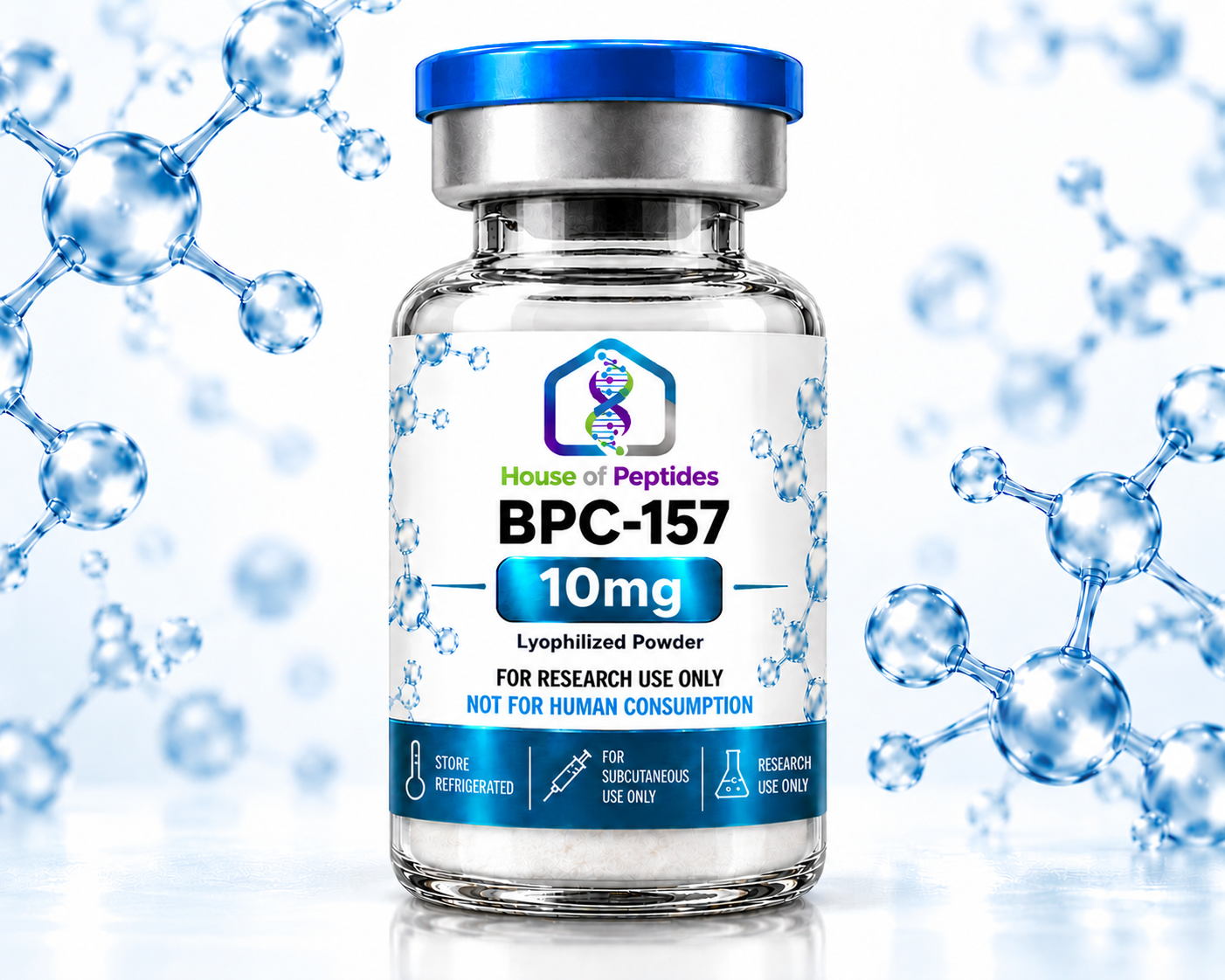
- Product: BPC-157 10mg
- Compound / formulation: BPC-157
- Labeled quantity / volume: 10mg per vial
- Physical form: White lyophilized powder
- Research focus: Tissue Repair Research, Gastrointestinal Research, Inflammatory Signaling, Angiogenesis Research
- Available batch identifiers: Black flip-off top / red aluminum seal, batch BP10-0609
- SKU: HOP-bpc-157-10mg
- Intended classification: Laboratory research only
Independent Laboratory Testing
Black top / red seal — Janoshik Analytical, report #196393 — Batch BP10-0609
- Compound reported: BPC-157
- Measured content: 11.95 mg
- Purity: 99.892%
- Test date: June 29, 2026
- View laboratory report
House of Peptides maintains an established testing and sampling protocol with its suppliers. Under this agreed protocol, samples are randomly selected from a production batch and submitted for independent laboratory analysis.
The submitted samples are drawn from the same production batch as the corresponding inventory supplied to House of Peptides. This batch-based sampling approach provides analytical information associated with the production batch rather than individual testing of every vial.
House of Peptides may maintain inventory from multiple production batches of the same compound. Each Certificate of Analysis corresponds to its identified batch, which may be distinguished by cap color or lot designation. Orders are fulfilled on a first-in, first-out (FIFO) basis, so the batch supplied depends on available inventory at the time of fulfillment. Laboratory findings apply to the submitted samples from their respective batches, not to every individual vial.
Scientific Research Background
BPC-157, also known as Body Protection Compound-157, is a synthetic peptide made from 15 amino acids derived from a sequence associated with gastric proteins.
Laboratory and animal investigations have examined its interactions with biological pathways involved in tissue integrity, vascular signaling, inflammatory responses, and cellular repair.
Experimental studies have reported changes in nitric oxide signaling, growth-factor-related pathways, and the formation of new blood vessels, a process known as angiogenesis. Researchers have also investigated BPC-157 in models involving tendon, ligament, muscle, and gastrointestinal tissue.
These findings have generated interest in the peptide's biological activity. However, the mechanisms remain incompletely characterized, and the available evidence from laboratory and animal studies has not established therapeutic effectiveness in humans.
Compound details
- Peptide length: 15 amino acids
- Research classification: Synthetic pentadecapeptide
Clinical Research Observations
Researchers have studied BPC-157 primarily in laboratory and animal experiments involving the digestive system, tendons, muscles, and other tissues.
1. What have tendon studies found about BPC-157?
Tendons connect muscles to bones. Researchers study their structure and strength when investigating how they respond to injury.
What researchers found: In a study involving rats with surgically injured Achilles tendons, researchers observed differences in tissue organization, tendon strength, and movement-related measurements compared with untreated animals.
The same investigators also examined tendon-producing cells in the laboratory. They found that BPC-157 counteracted the growth-inhibiting effects of a substance associated with tissue damage; the peptide did not independently increase cell growth under every experimental condition.
These findings are relevant because tendons connect muscles to bones and rely on organized connective tissue to withstand physical stress.
Why it matters: Tendon findings in rats cannot establish healing effects in humans.
2. What have muscle and ligament experiments shown?
Muscles and ligaments have different jobs, so researchers examine their responses to injury separately.
What researchers found: In other rat experiments, researchers studied injuries involving ligaments and the connection between muscle and tendon. They reported differences in tissue structure, strength, and movement-related measurements compared with untreated groups.
Why it matters: These studies help scientists investigate how different connective tissues respond after experimental injury. These experiments investigate how injured connective tissues respond, not proven human recovery benefits.
3. Why are researchers studying BPC-157 in the digestive system?
The lining of the stomach and intestines helps protect these tissues. Researchers have examined how it responds in experimental injury models.
What researchers found: BPC-157 has also been investigated in animal models involving the stomach and intestinal tract. Researchers have examined changes in tissue damage, inflammation, and the protective lining of the digestive system.
Why it matters: This work explores how the peptide interacts with processes involved in maintaining digestive tissues. Animal digestive models help identify mechanisms but do not establish treatment effects in people.
4. What evidence exists from human studies?
Results from animals need to be tested in people before researchers can draw conclusions about human benefits.
What researchers found: Some studies have reported changes in healing-related processes and inflammation. These findings are promising areas for further investigation, but animal research cannot tell us whether the same results would occur in humans.
Human clinical evidence remains limited, and the safety and effectiveness of BPC-157 in people have not been established.
Why it matters: There is too little human evidence to establish effectiveness or safety.
Published Scientific Research
Vasireddi et al. (2025) — Emerging Use of BPC-157 in Orthopaedic Sports Medicine: A Systematic Review. HSS Journal.
DOI: https://doi.org/10.1177/15563316251355551
Józwiak et al. (2025) — Multifunctionality and Possible Medical Application of the BPC 157 Peptide—Literature and Patent Review. Pharmaceuticals.
DOI: https://doi.org/10.3390/ph18020185
Demirtaş (2026) — BPC 157 in Rodent Ischemia-Reperfusion Injury: A Critical Review of Preclinical Evidence. International Journal of Molecular Sciences.
DOI: https://doi.org/10.3390/ijms27188344
Staresinic et al. (2003) — Gastric Pentadecapeptide BPC 157 Accelerates Healing of Transected Rat Achilles Tendon and In Vitro Stimulates Tendocytes Growth. Journal of Orthopaedic Research. Primary rat and cell-culture study.
DOI: https://doi.org/10.1016/S0736-0266(03)00110-4
Cerovecki et al. (2010) — Pentadecapeptide BPC 157 (PL 14736) Improves Ligament Healing in the Rat. Journal of Orthopaedic Research. Primary rat study.
DOI: https://doi.org/10.1002/jor.21107
Japjec et al. (2021) — Stable Gastric Pentadecapeptide BPC 157 as a Therapy for the Disable Myotendinous Junctions in Rats. Biomedicines. Primary rat study of the muscle–tendon junction, with structural, functional, and biomechanical assessments. https://pubmed.ncbi.nlm.nih.gov/34829776/ DOI: 10.3390/biomedicines9111547. Supports Clinical Question 2; animal evidence only.
Understanding the Research Findings
The published findings described above primarily concern experimental materials evaluated in preclinical research.
Even when independent laboratory testing identifies BPC-157 in a submitted sample, compound identification alone does not establish pharmaceutical equivalence, clinical effectiveness, or safety.
BPC-157 is not an FDA-approved medication. The available human evidence is limited, and the FDA has identified unresolved safety concerns involving peptide-related impurities and potential immune reactions.
House of Peptides' research product is not represented as clinically equivalent to materials evaluated in published investigations.
Research Use Notice
For laboratory research only. Not intended for human or veterinary administration, diagnostic, or therapeutic use.


Reviews
There are no reviews yet.