
Description
Product Specifications
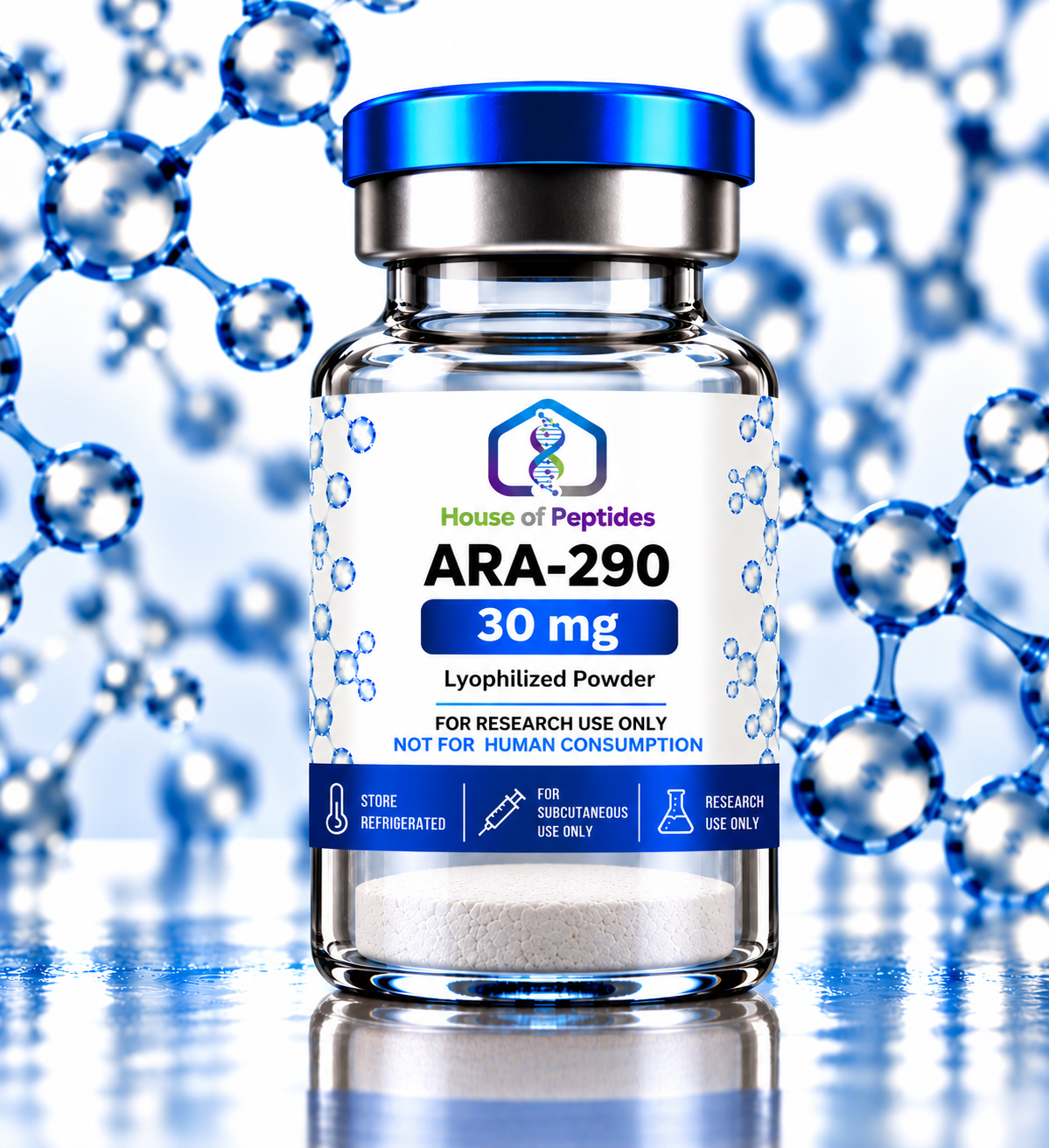
- Product: ARA-290 30mg
- Compound / formulation: Cibinetide (ARA-290)
- Labeled quantity / volume: 30mg per vial
- Physical form: White lyophilized powder
- Research focus: Tissue-protection signaling and small nerve fiber biology
- Available batch identifiers: Pink cap (report sample photograph); Chromate report #41719
- SKU: HOP-ARA290-30MG
- Intended classification: Laboratory research only
Independent Laboratory Testing
Pink cap — Chromate Laboratory, report #41719
- Compound reported: ARA290
- Measured content: 30.89mg
- Purity: 99.486%
- Sample received: October 29, 2026
- Analysis conducted: November 3, 2026
- View laboratory report
House of Peptides maintains an established testing and sampling protocol with its suppliers. Under this agreed protocol, samples are randomly selected from a production batch and submitted for independent laboratory analysis.
The submitted samples are drawn from the same production batch as the corresponding inventory supplied to House of Peptides. This batch-based sampling approach provides analytical information associated with the production batch rather than individual testing of every vial.
House of Peptides may maintain inventory from multiple production batches of the same compound. Each Certificate of Analysis corresponds to its identified batch, which may be distinguished by cap color or lot designation. Orders are fulfilled on a first-in, first-out (FIFO) basis, so the batch supplied depends on available inventory at the time of fulfillment. Laboratory findings apply to the submitted samples from their respective batches, not to every individual vial.
Scientific Research Background
Small nerve fibers help us sense temperature and pain. They also help regulate automatic functions, such as sweating. Damage to these fibers can cause burning, tingling, numbness, or other uncomfortable sensations.
ARA-290, also known as cibinetide, is a synthetic peptide made from 11 amino acids. Its design is based on part of the three-dimensional structure of erythropoietin, or EPO.
EPO is best known for helping the body produce red blood cells. It also has a role in the way tissues respond to injury. ARA-290 was designed to explore this tissue-protection signaling without stimulating red blood cell production.
Researchers describe the signaling target as the innate repair receptor—a receptor system involved in responses to tissue stress and inflammation.
Research has progressed from laboratory and animal experiments to small human trials, particularly in people with sarcoidosis or type 2 diabetes who have nerve-related symptoms. Sarcoidosis is an inflammatory disease that can affect several organs and may be accompanied by small nerve fiber problems.
The studies have measured both how people feel and changes in nerve fibers. These are different outcomes, and improvement in one does not automatically establish improvement in the other.
Clinical Research Observations
1. Why are scientists interested in ARA-290?
When tissue is injured, the body sends signals that influence inflammation and repair. Researchers have investigated whether parts of the EPO molecule can influence these signals separately from its role in red blood cell production.
What researchers found: A 2008 study of peptides modeled on EPO reported tissue-protective effects in laboratory and animal experiments without stimulating red blood cell production. This work helped establish the design approach behind ARA-290.
Why it matters: It gives scientists a way to study tissue-protection signals separately from EPO's blood-building effects. These early experiments do not establish benefits in people.
2. What did an early human study find about nerve-related symptoms?
Small nerve fiber problems can affect more than pain alone. Researchers use questionnaires to capture a wider range of symptoms and their effect on daily life.
What researchers found: In a 2012 placebo-controlled pilot study involving 22 people with sarcoidosis and small fiber neuropathy symptoms, the ARA-290 group had a greater improvement on a questionnaire covering those symptoms. A separate pain rating improved by a similar amount in both groups.
Why it matters: The study suggested a possible effect on the broader symptom picture. It did not demonstrate a consistent advantage across every measure of pain.
3. Have researchers seen changes in the nerve fibers themselves?
The cornea is the clear surface at the front of the eye. Special imaging can show its small nerve fibers, giving researchers a way to study nerve changes alongside symptom reports.
What researchers found: A 2013 placebo-controlled study enrolled 38 people with sarcoidosis and nerve-related symptoms. After 28 days, corneal nerve fiber area increased compared with the starting measurement in the ARA-290 group. The study also reported improved symptom scores. Changes in nerve fiber density in leg skin samples were not statistically significant.
Why it matters: These findings encouraged further investigation of nerve structure. A change measured in the cornea does not establish that damaged nerves throughout the body have recovered.
4. Did a later trial confirm the same pattern?
Later studies help researchers test whether early observations hold up. They can also show whether a structural change is accompanied by a clear difference in symptoms.
What researchers found: A 2017 randomized trial involving 64 people with sarcoidosis-associated small nerve fiber loss compared three cibinetide groups with placebo. One active group showed a statistically significant increase in corneal nerve fiber area compared with placebo; the other two did not. Pain improved in all groups, and the reported pain advantage in a subgroup did not reach statistical significance.
Why it matters: The nerve measurement was encouraging, but the pain results were less clear. More nerve fibers on an image and reliable pain relief are separate findings.
5. What has research in type 2 diabetes shown?
Diabetes can damage small nerve fibers. Researchers have studied ARA-290 in people with type 2 diabetes and painful nerve symptoms, measuring both symptoms and blood sugar control.
What researchers found: A placebo-controlled study published online in 2014 enrolled 49 people and analyzed 48. The ARA-290 group improved more on one nerve-symptom questionnaire and showed a modest improvement in HbA1c, a blood test reflecting blood sugar levels over time. Other nerve-symptom questionnaires did not show the same pattern of benefit.
Why it matters: The results identify questions for further study. They do not establish ARA-290 as a diabetes treatment or show that it consistently improves all nerve-related symptoms.
6. What is the overall scientific takeaway?
ARA-290 has been studied in people, as well as in laboratory and animal experiments. The human studies are useful because they examine both symptoms and measurable nerve changes.
What researchers found: Some trials reported encouraging nerve measurements or symptom scores, but the findings were not consistent across all outcomes. Safety observations also need context: the diabetes study reported serious adverse events, including events investigators considered possibly related to the study compound.
Why it matters: Short, relatively small trials cannot settle long-term effectiveness or safety. The findings support continued research, and cannot automatically be applied to this separately sourced research vial.
Published Scientific Research
Brines et al. (2008) — Peptide design based on EPO's structure. Proceedings of the National Academy of Sciences, 105(31):10925–10930. Laboratory and animal experiments examining tissue-protective peptides without red blood cell stimulation. Read paper. DOI:
10.1073/pnas.0805594105. Supports: Background; Question 1.Heij et al. (2012) — Sarcoidosis pilot trial. Molecular Medicine, 18:1430–1436. Placebo-controlled study of nerve-related symptoms in 22 participants. Read paper. DOI:
10.2119/molmed.2012.00332. Supports: Question 2.Dahan et al. (2013) — Symptoms and small nerve fiber measurements. Molecular Medicine, 19:334–345. Placebo-controlled study enrolling 38 people with sarcoidosis and nerve-related symptoms. Read paper. DOI:
10.2119/molmed.2013.00122. Supports: Question 3.Culver et al. (2017) — Cibinetide and corneal nerve fiber abundance. Investigative Ophthalmology & Visual Science, 58(6):BIO52–BIO60. Randomized, placebo-controlled study of 64 participants with sarcoidosis-associated small nerve fiber loss and neuropathic pain. PubMed — PMID 28475703. DOI:
10.1167/iovs.16-21291. Supports: Question 4.Brines et al. (2014 online; PubMed publication date 2015) — Type 2 diabetes and painful neuropathy. Molecular Medicine, 20:658–666. Placebo-controlled study assessing nerve-related symptoms, metabolic measurements, and safety. Read paper. DOI:
10.2119/molmed.2014.00215. Supports: Questions 5–6.
Understanding the Research Findings
ARA-290 research examines a specific approach to tissue-protection signaling. Human trials have reported changes in some small nerve fiber measurements and symptom scores, alongside outcomes that did not show a clear advantage over placebo.
The condition studied, the measurement used, and the study's size and duration all affect what can be concluded. Results obtained with clinical trial material do not establish the same effects or safety for an independently sourced research product.
Research Use Notice
For laboratory research only. Not intended for human or veterinary administration, diagnostic, or therapeutic use.




Reviews
There are no reviews yet.