Description
Product Specifications
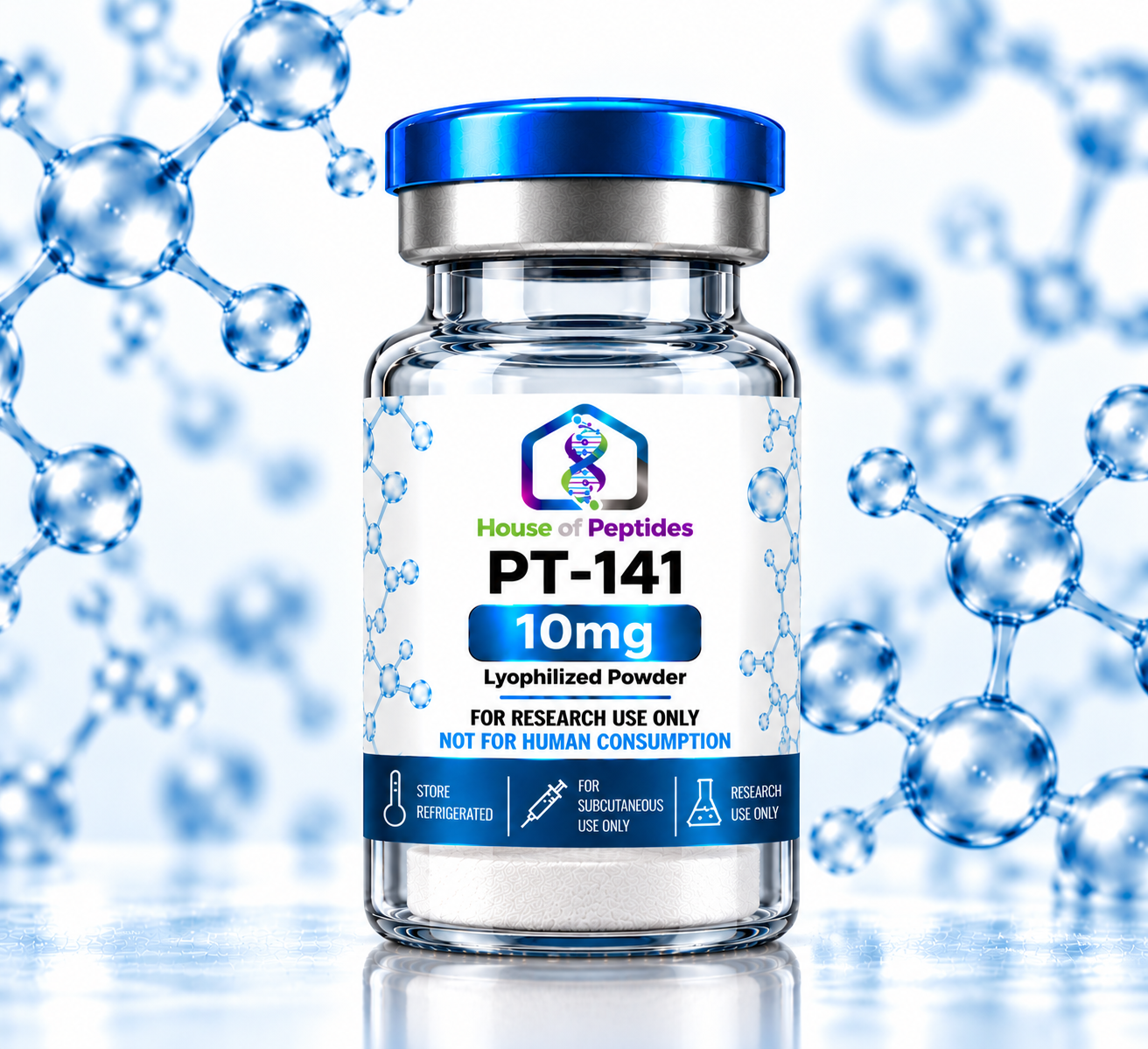
- Product: PT-141 10mg
- Compound / formulation: PT-141 (Bremelanotide)
- Labeled quantity / volume: 10mg per vial
- Physical form: White lyophilized powder
- Research focus: Melanocortin Signaling, Sexual Behavior Research, Neuroendocrine Research
- Available batch identifiers: Pink
- SKU: HOP-PT-141-10MG
- Intended classification: Laboratory research only
Independent Laboratory Testing
Pink cap — Chromate Laboratory, report #38861
- Compound reported: PT-141 10mg
- Measured content: 11.05mg
- Purity: 99.638%
- Test date: August 27, 2026
- View laboratory report
House of Peptides maintains an established testing and sampling protocol with its suppliers. Under this agreed protocol, samples are randomly selected from a production batch and submitted for independent laboratory analysis.
The submitted samples are drawn from the same production batch as the corresponding inventory supplied to House of Peptides. This batch-based sampling approach provides analytical information associated with the production batch rather than individual testing of every vial.
House of Peptides may maintain inventory from multiple production batches of the same compound. Each Certificate of Analysis corresponds to its identified batch, which may be distinguished by cap color or lot designation. Orders are fulfilled on a first-in, first-out (FIFO) basis, so the batch supplied depends on available inventory at the time of fulfillment. Laboratory findings apply to the submitted samples from their respective batches, not to every individual vial.
Scientific Research Background
Sexual desire involves communication between the brain, hormones, emotions, and the body's physical responses.
PT-141 belongs to a group of compounds called melanocortin receptor agonists. These compounds interact with signaling pathways involved in several biological functions, including sexual behavior.
Researchers have investigated whether activating these pathways can influence sexual desire, particularly in people experiencing persistent difficulties with desire.
A pharmaceutical formulation of bremelanotide has been approved for a specific form of low sexual desire in premenopausal women. This approval does not extend to independently sourced PT-141 research materials.
Compound details
- Research classification: Melanocortin receptor agonist
Clinical Research Observations
Researchers have studied PT-141 to better understand how the brain influences sexual desire and why some people experience a persistent loss of interest in sexual activity.
1. What have studies found about PT-141 and sexual desire in women?
Researchers have studied women whose persistent low sexual desire was causing distress.
What researchers found: In two large clinical trials involving more than 1,200 women, researchers investigated bremelanotide in women experiencing low sexual desire that was causing personal distress.
They found that women receiving bremelanotide reported greater improvements in sexual desire and reductions in related distress than women receiving a placebo.
These findings were important because they demonstrated that influencing certain brain signaling pathways could affect sexual desire.
Why it matters: Results from specific clinical formulations cannot be transferred to independently sourced vials.
2. How is sexual desire different from physical arousal?
Sexual interest and a physical sexual response are related, but they are different measurements.
What researchers found: Researchers have investigated PT-141 partly because it may influence signals associated with sexual interest rather than acting only on blood circulation.
This distinction helps explain why scientists study different biological pathways when investigating sexual function.
Why it matters: These are distinct outcomes and should not be presented as interchangeable.
3. What has been studied in men?
Studies in men involve different participants and questions from studies in women.
What researchers found: Early clinical research also investigated PT-141 in men, including its potential effects on erectile responses.
These studies contributed to researchers' understanding of how brain signaling can influence sexual function. However, the evidence is more limited than the clinical research conducted in women, and PT-141 is not FDA-approved for treating sexual dysfunction in men.
Why it matters: Findings in one population cannot establish effects in another.
4. What side effects have clinical studies reported?
Researchers track unwanted effects alongside changes in sexual desire.
What researchers found: Clinical trials also identified important safety considerations.
Nausea, flushing, and headaches were among the commonly reported side effects. Researchers also observed temporary increases in blood pressure.
These findings demonstrate why researchers must evaluate safety alongside any observed changes in sexual desire.
Why it matters: Safety observations are essential alongside reported outcomes.
5. What is the overall scientific takeaway?
The studied preparation and the participants both affect what a trial can establish.
What researchers found: Human clinical studies have demonstrated that the bremelanotide preparation used in the trials can influence sexual desire in certain women experiencing persistent low desire.
The research has also helped scientists better understand the relationship between brain signaling and sexual function.
However, those findings apply to specific medicines prepared for the studies studied under controlled conditions. They do not establish equivalent effectiveness or safety for independently sourced PT-141 research products.
Why it matters: Clinical evidence for a prescription formulation does not validate this research vial.
Published Scientific Research
- Kingsberg et al. (2019), Bremelanotide for the Treatment of Hypoactive Sexual Desire Disorder: Two Randomized Phase 3 Trials. https://pmc.ncbi.nlm.nih.gov/articles/PMC6819021/
- Simon et al. (2019), Long-Term Safety and Efficacy of Bremelanotide for Hypoactive Sexual Desire Disorder. https://pmc.ncbi.nlm.nih.gov/articles/PMC6819023/
- Edinoff et al. (2022), Bremelanotide for Treatment of Female Hypoactive Sexual Desire. Review of clinical research. https://pmc.ncbi.nlm.nih.gov/articles/PMC8788464/
- Diamond et al. (2004), Double-blind, placebo-controlled evaluation of the safety, pharmacokinetic properties and pharmacodynamic effects of intranasal PT-141, a melanocortin receptor agonist, in healthy males and patients with mild-to-moderate erectile dysfunction. International Journal of Impotence Research, 16(1), 51–59. https://pubmed.ncbi.nlm.nih.gov/14963471/ DOI:
10.1038/sj.ijir.3901139. Primary early male clinical research underlying Clinical Question 3; its formulation and route differ from this research vial.
Understanding the Research Findings
Clinical research involving pharmaceutical bremelanotide provides evidence of its effects on sexual desire in a specific patient population.
The independently tested House of Peptides sample has reported analytical findings concerning peptide quantity and purity. Those findings do not establish pharmaceutical equivalence, clinical effectiveness, sterility, or safety for human administration.
Although prescription bremelanotide is FDA-approved for a specific indication, House of Peptides PT-141 is an independently sourced research material and is not an FDA-approved medication.
Research Use Notice
For laboratory research only. Not intended for human or veterinary administration, diagnostic, or therapeutic use.


Reviews
There are no reviews yet.