Description
Product Specifications
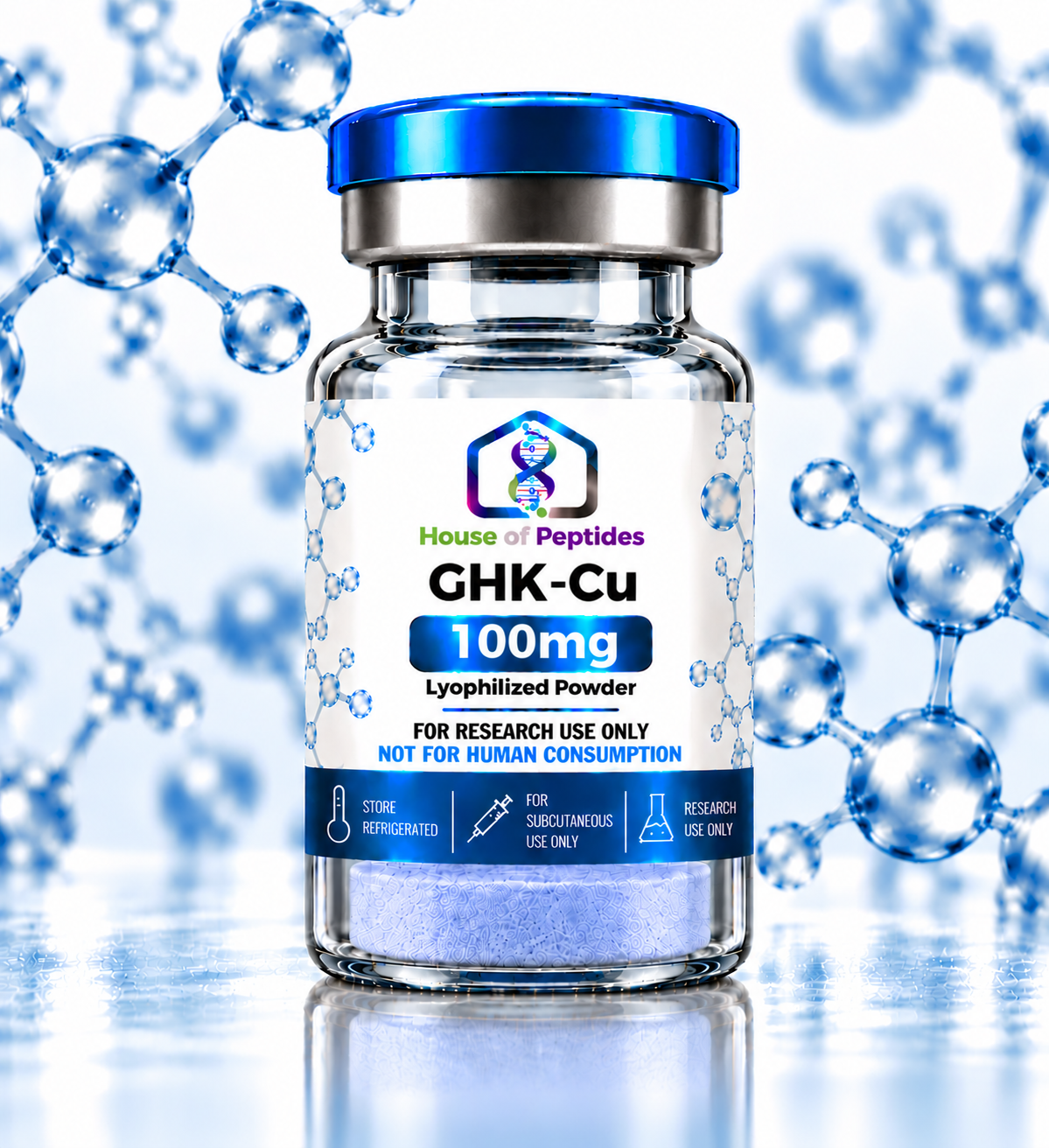
- Product: GHK-Cu 100mg
- Compound / formulation: GHK-Cu (Copper Tripeptide-1)
- Labeled quantity / volume: 100mg per vial
- Physical form: Blue lyophilized powder
- Research focus: Skin biology, collagen signaling, tissue remodeling
- Available batch identifiers: Transparent cap (Freedom Diagnostics accession 26G09100326); amber/yellow cap, batch HK100-0531
- SKU: HOP-GHK-CU-100MG
- Intended classification: Laboratory research only
Independent Laboratory Testing
Transparent cap — Freedom Diagnostics, accession 26G09100326
- Compound reported: GHK-Cu 100mg
- Identity reported: Confirmed by LC-MS
- Measured content: 101.95mg
- Purity: 99.88%
- Report date: September 11, 2026
- View laboratory report
Amber/yellow cap — Janoshik Analytical, report #172723 — Batch HK100-0531
- Compound reported: GHK-Cu 100mg
- Measured GHK-Cu content: 111.29mg
- Purity: 99.764%
- Test date: June 16, 2026
- View laboratory report
House of Peptides maintains an established testing and sampling protocol with its suppliers. Under this agreed protocol, samples are randomly selected from a production batch and submitted for independent laboratory analysis.
The submitted samples are drawn from the same production batch as the corresponding inventory supplied to House of Peptides. This batch-based sampling approach provides analytical information associated with the production batch rather than individual testing of every vial.
House of Peptides may maintain inventory from multiple production batches of the same compound. Each Certificate of Analysis corresponds to its identified batch, which may be distinguished by cap color or lot designation. Orders are fulfilled on a first-in, first-out (FIFO) basis, so the batch supplied depends on available inventory at the time of fulfillment. Laboratory findings apply to the submitted samples from their respective batches, not to every individual vial.
Scientific Research Background
GHK-Cu combines a naturally occurring three-amino-acid peptide, glycyl-L-histidyl-L-lysine (GHK), with copper.
GHK occurs naturally in the human body. When it binds copper, it forms a complex that researchers study for its effects on cellular communication and tissue maintenance.
Scientists are particularly interested in GHK-Cu because collagen production, connective-tissue remodeling, and responses to tissue injury involve multiple coordinated biological processes.
Research has examined these processes in cultured cells, animal models, and a limited number of human topical-product studies. Most evidence supporting tissue-repair mechanisms remains preclinical.
Compound details
- Peptide sequence: Gly-His-Lys
- Research classification: Copper-binding peptide complex
Clinical Research Observations
Researchers have studied GHK-Cu to understand how skin and other tissues maintain themselves, respond to damage, and rebuild their supporting structures.
Much of this research has involved laboratory experiments and animals. Human studies have generally been small and have focused on topical cosmetic formulations.
1. What have studies shown about GHK-Cu and collagen?
Collagen gives skin and connective tissue structure and strength.
What researchers found: In laboratory experiments, researchers exposed skin-supporting cells called fibroblasts to GHK-Cu.
They observed increased collagen production, suggesting that GHK-Cu can influence one of the processes involved in maintaining and rebuilding connective tissue.
These findings help explain why researchers are interested in GHK-Cu for skin and tissue biology. However, increased collagen production in laboratory cells does not necessarily mean a product will produce visible skin improvements in humans.
Why it matters: Cellular collagen measurements do not prove visible skin improvements.
2. How is GHK-Cu involved in tissue remodeling?
Tissue maintenance involves organizing and replacing material as well as making it.
What researchers found: Researchers found that GHK-Cu influenced proteins involved in breaking down and reorganizing connective tissue.
This is important because healthy tissue maintenance involves a balance between building new structures and removing or reorganizing older ones.
These experiments suggest that GHK-Cu participates in tissue-remodeling pathways, but they do not establish that it accelerates wound healing in people.
Why it matters: Tissue remodeling in models is not equivalent to faster healing in people.
3. What have damaged-cell experiments found?
Researchers use cultured skin cells to examine responses following radiation exposure.
What researchers found: Scientists have also investigated GHK-Cu in skin cells affected by radiation.
In one laboratory study, researchers examined fibroblasts obtained from previously irradiated tissue.
Cells exposed to GHK-Cu multiplied more quickly than untreated cells, and researchers observed changes in certain growth-related signals.
These results helped scientists explore how damaged cells respond to chemical signals involved in tissue maintenance.
The experiment was conducted in cells grown in a laboratory, not as a clinical treatment for radiation-related skin damage.
Why it matters: Cultured-cell findings are not clinical treatment evidence.
4. What have human skin studies shown?
Human cosmetic studies test particular preparations and measurements.
What researchers found: Researchers have investigated copper-peptide formulations in small human cosmetic studies.
Some studies reported improvements in selected skin-related measurements, while others found no clear objective advantage.
For example, a small study involving people recovering from laser skin resurfacing did not demonstrate significant improvements in several objectively measured outcomes.
More recently, a small study of a topical GHK-Cu formulation reported improvements in eyebrow-hair measurements. However, this was not evidence of improved scalp hair growth, wound healing, or benefits from other forms of GHK-Cu.
These mixed and limited findings show why results from laboratory experiments must be tested carefully in people.
Why it matters: Small topical studies cannot validate other formulations or routes.
5. What is the overall scientific takeaway?
The types of studies available help determine what conclusions can be drawn.
What researchers found: Laboratory and animal studies indicate that GHK-Cu can influence collagen production, connective-tissue remodeling, and cellular responses associated with tissue maintenance.
These findings provide a scientific basis for continued research into skin biology and tissue repair.
However, available human evidence remains limited. Researchers have not established that independently sourced GHK-Cu research products safely or effectively improve skin appearance, wound healing, hair growth, or other health outcomes.
Why it matters: Laboratory findings support research but not broad clinical claims.
Published Scientific Research
Maquart et al. (1988) — Stimulation of collagen synthesis in fibroblast cultures by the tripeptide-copper complex glycyl-L-histidyl-L-lysine-Cu2+. Laboratory research examining collagen production. https://pubmed.ncbi.nlm.nih.gov/3169264/
Siméon et al. (2000) — The tripeptide-copper complex glycyl-L-histidyl-L-lysine-Cu2+ stimulates matrix metalloproteinase-2 expression by fibroblast cultures. Research investigating connective-tissue remodeling. https://pubmed.ncbi.nlm.nih.gov/11045606/
Pollard et al. (2005) — Effects of Copper Tripeptide on the Growth and Expression of Growth Factors by Normal and Irradiated Fibroblasts. Cell-culture research examining growth-related signaling. https://pubmed.ncbi.nlm.nih.gov/15655171/
Pickart, Vasquez-Soltero, and Margolina (2015) — GHK Peptide as a Natural Modulator of Multiple Cellular Pathways in Skin Regeneration. Review of experimental findings concerning skin and tissue biology. https://pubmed.ncbi.nlm.nih.gov/26236730/
Mateescu et al. (2026) — GHK-Cu as a Bioactive Metallopeptide and Drug-Delivery Cargo: Coordination Chemistry, Formulation Science, Therapeutic Evidence, and a Translational Roadmap. Review distinguishing substantial preclinical research from limited human evidence and discussing chemical characterization challenges. https://pubmed.ncbi.nlm.nih.gov/42797253/
Miller et al. (2006) — Effects of topical copper tripeptide complex on CO2 laser-resurfaced skin. Archives of Facial Plastic Surgery. Primary randomized topical-regimen study; 13 completers, no significant objective between-group improvement, despite a patient-satisfaction difference. https://pubmed.ncbi.nlm.nih.gov/16847171/ DOI:
10.1001/archfaci.8.4.252. Supports Clinical Question 4.Bo et al. (2026) — The efficacy of 2% copper peptide (GHK-Cu) serum for eyebrow hypotrichosis: a randomized, double-blind, vehicle-controlled, split-face comparative study. Procedia of Multidisciplinary Research. Small topical eyebrow study; not evidence about scalp hair or this vial. https://so09.tci-thaijo.org/index.php/PMR/article/view/9318 Supports Clinical Question 4.
Understanding the Research Findings
GHK-Cu has been investigated for its effects on collagen production, connective-tissue organization, and cellular responses associated with tissue maintenance.
These findings are scientifically interesting, but most supporting studies involve cultured cells or animals. Limited human cosmetic research does not establish broad clinical benefits.
The independent laboratory certificates associated with House of Peptides inventory provide analytical information about identity, quantity, and purity for the submitted batch samples.
They do not establish sterility, endotoxin clearance, pharmaceutical equivalence, clinical effectiveness, or safety for human administration.
House of Peptides GHK-Cu 100mg is an independently sourced laboratory research material, not an FDA-approved medication.
Research Use Notice
For laboratory research only. Not intended for human or veterinary administration, diagnostic, or therapeutic use.


Reviews
There are no reviews yet.