
Description
Product Specifications
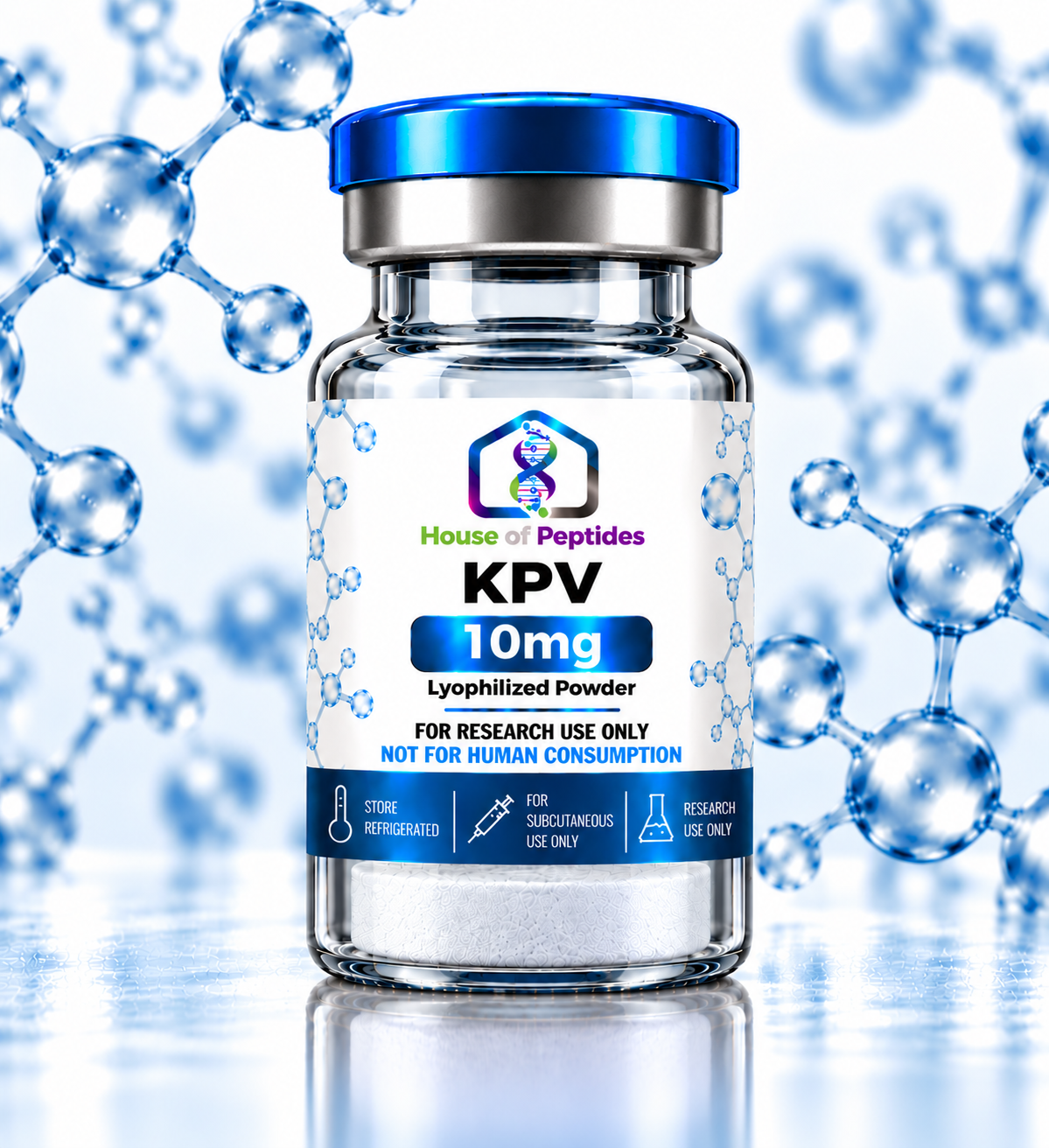
- Product: KPV 10mg
- Compound / formulation: KPV
- Labeled quantity / volume: 10mg
- Physical form: White lyophilized powder
- Research focus: Recovery & Healing Research
- Available batch identifiers: Gold/yellow cap, batch KP10-0607; pink/purple cap / dark-purple collar, batch KP10-0904
- SKU: HOP-KPV-10MG
- Intended classification: Laboratory research use only
Independent Laboratory Testing
Janoshik Analytical, report #197409 — Batch KP10-0607
- Compound reported: KPV
- Measured content: 12.39mg
- Purity: 99.484%
- Test date: July 1, 2026
- View laboratory report
Pink/purple cap / dark-purple collar — Janoshik, report #233485 — Batch KP10-0904
- Compound reported: KPV
- Measured content: 11.56mg
- Purity: 99.103%
- Test date: September 25, 2026
- Verification key: N2NY5QZCBTK1
- View laboratory report
House of Peptides maintains an established testing and sampling protocol with its suppliers. Under this agreed protocol, samples are randomly selected from a production batch and submitted for independent laboratory analysis.
The submitted samples are drawn from the same production batch as the corresponding inventory supplied to House of Peptides. This batch-based sampling approach provides analytical information associated with the production batch rather than individual testing of every vial.
House of Peptides may maintain inventory from multiple production batches of the same compound. Each Certificate of Analysis corresponds to its identified batch, which may be distinguished by cap color or lot designation. Orders are fulfilled on a first-in, first-out (FIFO) basis, so the batch supplied depends on available inventory at the time of fulfillment. Laboratory findings apply to the submitted samples from their respective batches, not to every individual vial.
Scientific Research Background
KPV is a short peptide made up of three amino acids: lysine, proline, and valine. It corresponds to a small portion of a naturally occurring hormone known as alpha-melanocyte-stimulating hormone (alpha-MSH).
Researchers have investigated KPV because of its interactions with cells involved in the body's inflammatory responses.
Much of this research has focused on intestinal tissue, including how KPV enters certain cells and affects signals associated with inflammation. More recently, researchers have also examined KPV in laboratory studies involving skin cells.
Compound details
- Peptide sequence: Lys-Pro-Val
Clinical Research Observations
1. What has KPV research shown in digestive tissue models?
Researchers have studied how intestinal cells and tissues respond to inflammation.
What researchers found: In laboratory studies involving intestinal and immune cells, researchers observed that KPV reduced certain signals associated with inflammation.
Researchers also studied KPV in mice with experimentally induced intestinal inflammation. They observed lower levels of some inflammatory markers and less inflammation in the affected intestinal tissues.
Why it matters: These findings have contributed to scientific interest in how KPV interacts with cells involved in maintaining the protective lining of the digestive system. Laboratory intestinal findings cannot establish treatment of digestive disease.
2. Why are scientists studying KPV in skin models?
Laboratory skin models allow scientists to examine how cells respond to environmental stress.
What researchers found: In a 2025 laboratory study, researchers examined skin cells exposed to fine dust particles, which can cause inflammation and cell damage.
When KPV was introduced under the experimental conditions, researchers observed reduced inflammation-related activity and less evidence of cell damage. The researchers also examined these effects in a laboratory model designed to resemble layers of human skin.
These findings are limited to laboratory research. They do not establish that KPV improves skin conditions in humans.
Why it matters: Experimental skin findings do not establish human dermatological outcomes.
3. What are the main limits of KPV research?
Knowing what was tested helps explain how far a finding can be applied.
What researchers found: The studies described above involved laboratory experiments and animal models, not controlled clinical trials demonstrating benefits in people.
Why it matters: The evidence remains preliminary and requires stronger human studies.
Published Scientific Research
Dalmasso et al. (2008) — PepT1-Mediated Tripeptide KPV Uptake Reduces Intestinal Inflammation. Gastroenterology.
Researchers investigated how KPV enters intestinal and immune cells and examined its effects on inflammation in laboratory experiments and mouse models.
Sung et al. (2025) — Lysine-Proline-Valine peptide mitigates fine dust-induced keratinocyte apoptosis and inflammation by regulating oxidative stress and modulating the MAPK/NF-κB pathway. Tissue and Cell.
Researchers examined KPV in skin cells exposed to fine dust particles and in a laboratory skin model. They reported changes in inflammation-related activity and cell damage under the experimental conditions.
Understanding the Research Findings
KPV research has produced observations of interest in intestinal and skin-cell studies, particularly those examining inflammatory responses.
However, results obtained from isolated cells, laboratory tissue models, and animals cannot automatically be applied to humans.
The published findings describe how KPV behaved under specific experimental conditions. They do not establish that KPV prevents, treats, or improves any medical condition in people.
Likewise, laboratory measurements of peptide purity and quantity describe the tested sample's analytical characteristics, not its clinical safety or effectiveness.
Research Use Notice
For laboratory research only. Not intended for human or veterinary administration, diagnostic, or therapeutic use.



Reviews
There are no reviews yet.