
Description
Product Specifications
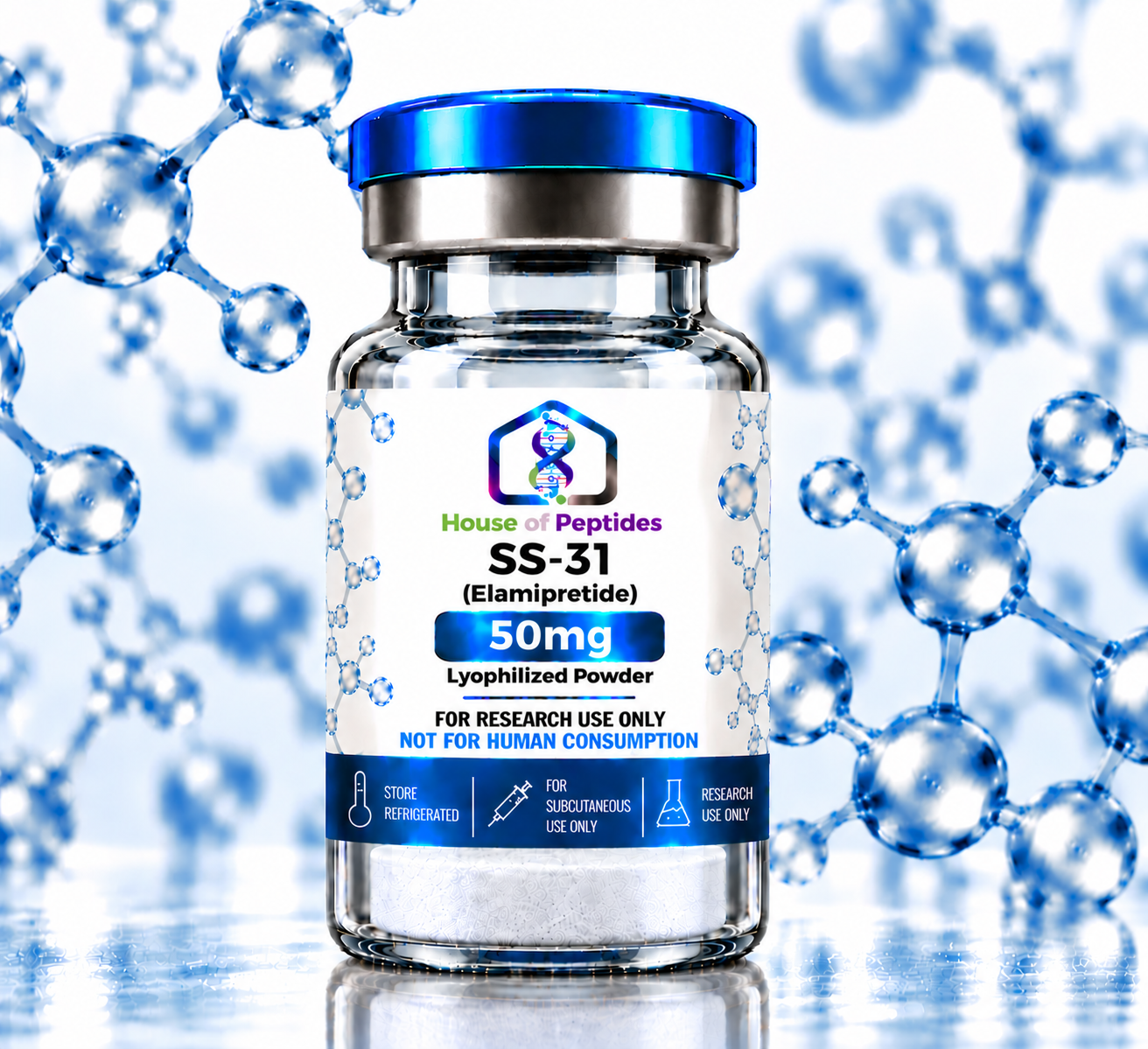
- Product: SS-31 50mg (Elamipretide)
- Compound / formulation: Elamipretide (SS-31)
- Labeled quantity / volume: 50mg per vial
- Physical form: White lyophilized powder
- Research focus: Mitochondrial membrane and cardiolipin biology
- Available batch identifiers: Golden-yellow cap; lime-green cap; clear blue cap, lot S250-HV-26
- SKU: HOP-SS31-50MG
- Intended classification: Laboratory research only
Independent Laboratory Testing
Golden-yellow cap — Janoshik, report #224657
- Compound reported: SS-31
- Measured content: 48.17mg
- Purity: 99.583%
- Test date: August 26, 2026
- View laboratory report
Lime-green cap — Freedom Diagnostics, accession 2609170319
- Compound reported: SS-31
- Measured content: 53.49mg
- Purity: 99.85%
- Report date: September 19, 2026
- View laboratory report
Clear blue cap — BT Labs — Lot S250-HV-26
- Compound reported: SS-31
- Measured content: 51.2mg
- Purity: 99.8%
- Test date: October 23, 2026
- View laboratory report
- View bacterial endotoxins report COA262049-015
House of Peptides maintains an established testing and sampling protocol with its suppliers. Under this agreed protocol, samples are randomly selected from a production batch and submitted for independent laboratory analysis.
The submitted samples are drawn from the same production batch as the corresponding inventory supplied to House of Peptides. This batch-based sampling approach provides analytical information associated with the production batch rather than individual testing of every vial.
House of Peptides may maintain inventory from multiple production batches of the same compound. Each Certificate of Analysis corresponds to its identified batch, which may be distinguished by cap color or lot designation. Orders are fulfilled on a first-in, first-out (FIFO) basis, so the batch supplied depends on available inventory at the time of fulfillment. Laboratory findings apply to the submitted samples from their respective batches, not to every individual vial.
Scientific Research Background
Mitochondria are tiny structures inside our cells that help turn nutrients into energy. They are especially important in organs and tissues that need large amounts of energy, such as the heart, muscles, and brain.
SS-31, also known as elamipretide, is a synthetic peptide studied for its interaction with mitochondria.
Scientists are particularly interested in how SS-31 interacts with cardiolipin, a substance that helps maintain the structure of mitochondrial membranes.
Researchers have investigated whether these interactions can influence how mitochondria produce energy and respond to stress.
SS-31 has been examined in laboratory experiments, animal studies, and human clinical trials. The results vary depending on the condition studied, and findings from one setting do not necessarily apply to another.
Clinical Research Observations
1. Why are scientists interested in SS-31?
Every cell in our body needs energy to function. Much of that energy comes from tiny structures called mitochondria.
Our muscles, heart, brain, and other organs depend on mitochondria to do their jobs.
SS-31 is a peptide that researchers study because of how it interacts with structures inside mitochondria.
What researchers found: SS-31 interacts with a special type of fat called cardiolipin, which helps maintain the structure and function of mitochondria.
Why it matters: Understanding this interaction may help scientists learn why mitochondria sometimes stop working properly and how their function might be protected.
2. Can SS-31 help cells produce energy?
Mitochondria convert nutrients into usable energy. When they become damaged or stressed, that process may become less efficient.
Scientists have investigated whether SS-31 can influence how mitochondria function under these conditions.
What researchers found: Some laboratory and animal studies have reported improvements in measurements of mitochondrial function after exposure to SS-31.
Why it matters: These findings help researchers explore ways to protect cellular energy production. However, better laboratory measurements do not automatically mean that a person will feel more energetic.
3. What have researchers discovered about muscle function?
Muscles require energy for movement, exercise, and everyday activities.
Researchers have studied SS-31 in people with conditions that affect how their muscles produce energy.
What researchers found: Early studies showed encouraging changes in certain measurements. However, a larger clinical trial involving 218 people with primary mitochondrial myopathy did not find significant improvements in walking distance or fatigue after 24 weeks.
Why it matters: This demonstrates why larger human studies are important. A compound may show promise in early research without producing the expected benefits in a larger clinical trial.
4. Why is SS-31 being studied in heart research?
The heart works continuously, so its cells need a reliable supply of energy.
Researchers have investigated whether SS-31 can influence how heart cells respond to stress, particularly when their energy-producing systems are affected.
What researchers found: Some laboratory and animal studies reported favorable changes in measurements related to mitochondrial function and heart-cell injury. Human research has produced mixed results.
Why it matters: This research helps scientists better understand the relationship between mitochondrial function and heart health. It does not establish that SS-31 prevents heart disease or improves heart function in healthy people.
5. What have human clinical trials shown?
SS-31 has been studied in human clinical trials involving several medical conditions.
These studies help researchers determine whether promising laboratory findings translate into meaningful improvements in people.
What researchers found: Results have varied. Some studies reported encouraging findings in selected measurements, while others did not demonstrate significant improvement in their main outcomes.
Why it matters: Human clinical trials provide a more reliable picture of what a compound may actually accomplish. They also show why results from laboratory or animal studies should not be treated as proof of human benefits.
6. Has SS-31 received FDA approval?
Yes. In September 2025, the FDA granted accelerated approval to a prescription medicine containing elamipretide, the scientific name for SS-31.
The medicine, called Forzinity, was approved to improve muscle strength in certain patients with Barth syndrome, a rare inherited condition that affects cellular energy production.
What researchers found: Increases in knee extensor muscle strength were observed during a longer, open-label study period. A significant benefit was not shown during the initial randomized period. Continued approval may depend on additional studies confirming clinical benefit.
Why it matters: This represents an important milestone in mitochondrial medicine. However, approval for one rare condition does not establish that SS-31 improves energy, exercise performance, or healthy aging in the general population.
The FDA-approved prescription product is not the same as the independently sourced SS-31 research vials sold by House of Peptides.
7. What is the overall scientific takeaway?
SS-31 has attracted scientific interest because of its interaction with mitochondria, the structures responsible for producing much of the energy our cells need.
Research has progressed from laboratory experiments to human clinical trials and an approved prescription medicine for a specific rare condition.
What researchers found: SS-31 can influence mitochondrial biology, but the clinical results differ depending on the condition being studied.
Why it matters: Understanding how a compound works is only the first step. Researchers must also demonstrate whether those effects produce meaningful benefits in specific circumstances.
Findings from clinical studies cannot automatically be applied to this particular research product.
Published Scientific Research
These references distinguish mechanistic laboratory findings, animal studies, human clinical trials, and regulatory findings. None establishes equivalence between a studied medicine and House of Peptides' SS-31 50mg vial.
Birk et al. (2014) — Cardiolipin binding and mitochondrial energy processes. British Journal of Pharmacology. Laboratory experiments using membrane models and mitochondrial preparations found that SS-31 interacted with cardiolipin and affected cytochrome-c-associated electron transport and ATP-synthesis measurements. These were not clinical energy or performance outcomes. PubMed — PMID 24134698. Supports: Scientific Background; Clinical Questions 1 and 2.
Sabbah et al. (2018) — Mitochondrial dynamics in experimental heart failure. Cardiovascular Drugs and Therapy. Investigated human and canine heart tissue and treated dogs with heart failure. Reported favorable changes in mitochondrial markers in the animal intervention; it did not establish clinical benefit in people. PubMed — PMID 29951944. Supports: Clinical Question 4, preclinical component.
Gibson et al. (2016) — EMBRACE STEMI. European Heart Journal. Randomized clinical trial of MTP-131/elamipretide in patients undergoing intervention for a first anterior ST-elevation myocardial infarction. The study did not show a significant reduction in its primary infarct-size outcome or improvements in prespecified secondary outcomes. PubMed — PMID 26586786. Supports: Clinical Questions 4 and 5; human cardiac evidence limitations.
Butler et al. (2020) — PROGRESS-HF. Journal of Cardiac Failure. Randomized, placebo-controlled trial of 71 patients with heart failure with reduced ejection fraction. Four weeks of elamipretide did not significantly improve the primary left-ventricular volume measure versus placebo. PubMed — PMID 32068002. Supports: Clinical Questions 4 and 5; mixed-to-negative human cardiac outcomes.
Karaa et al. (2023) — MMPOWER-3. Neurology. Randomized, placebo-controlled, 24-week trial of 218 participants with primary mitochondrial myopathy. The study did not meet its primary walking-distance or fatigue endpoints. PubMed — PMID 37268435. Supports: Clinical Questions 3, 5, and 7.
U.S. Food and Drug Administration (2025) — Forzinity Drug Trials Snapshot. Official regulatory information describing Forzinity's indication for improving muscle strength in adults and children with Barth syndrome weighing at least 30 kg. This approval applies to the specific regulated prescription medicine, not to House of Peptides' research vial. FDA — Forzinity. Supports: Clinical Question 6.
Evidence boundary: Mechanistic and animal findings do not demonstrate human benefit. Results from individual clinical conditions cannot be generalized to healthy adults or to a separately sourced research product.
Understanding the Research Findings
SS-31 has been studied in cells, animals, and people. Evidence varies by condition and study design. A clinical finding for one manufactured formulation does not establish a comparable effect for an independently sourced vial. FDA approval of Forzinity does not apply to House of Peptides' SS-31 50mg research product.
Research Use Notice
For laboratory research only. Not intended for human or veterinary administration, diagnostic, or therapeutic use.


Reviews
There are no reviews yet.