Description
Product Specifications
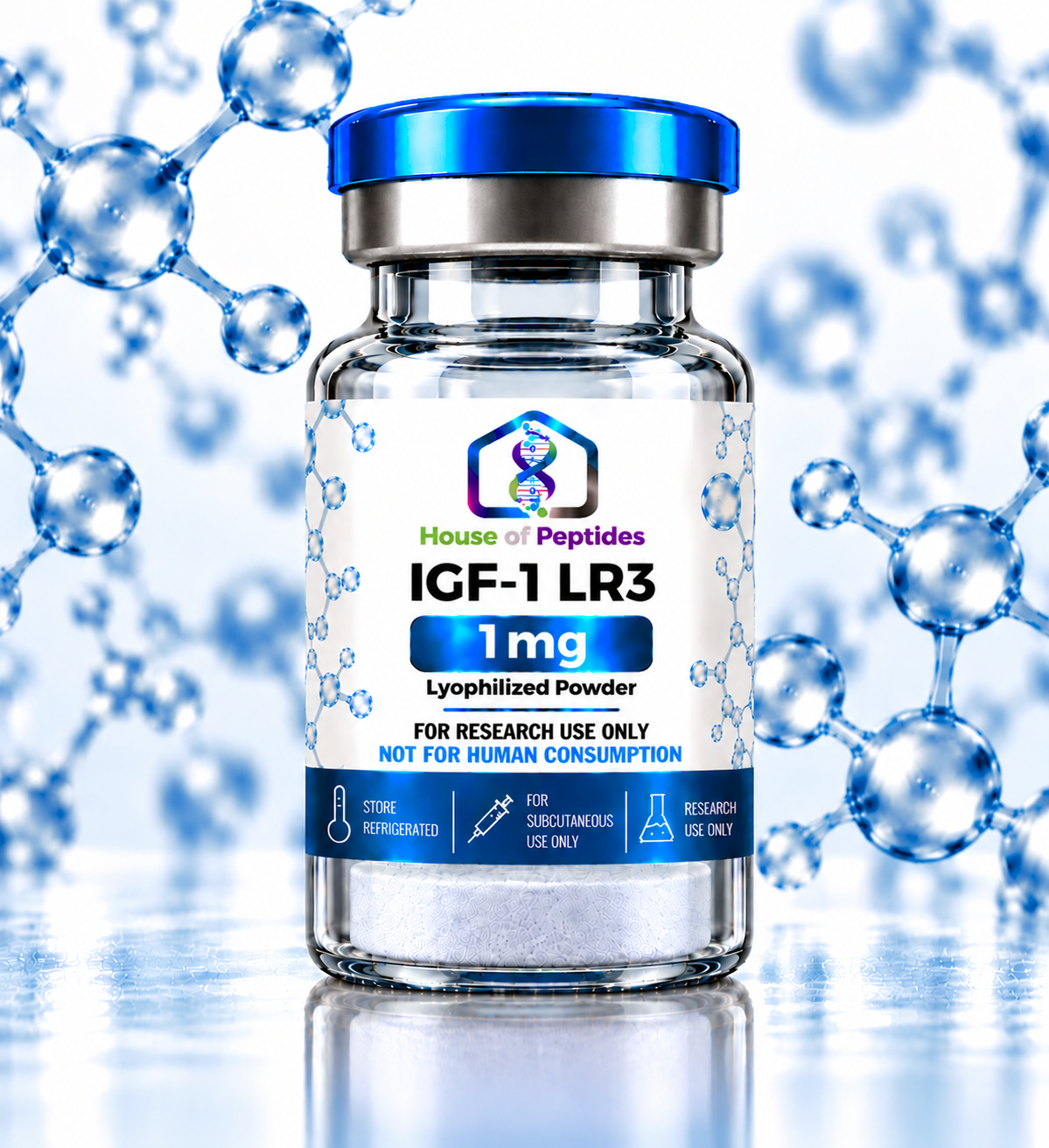
- Product: IGF-1 LR3 1mg
- Compound / formulation: IGF-1 LR3 (Long R3 IGF-1)
- Labeled quantity / volume: 1mg per vial
- Physical form: White lyophilized powder
- Research focus: Growth Factor Research, Cellular Signaling, Protein Metabolism, Tissue Development Research
- Available batch identifiers: Black
- SKU: HOP-IGF1-LR3-1MG
- Intended classification: Laboratory research only
Independent Laboratory Testing
Black cap — Janoshik Analytical, report #89869
- Compound reported: IGF LR3 1mg
- Measured content: 1.19mg
- Purity: 99.539%
- Test date: November 25, 2025
- View laboratory report
House of Peptides maintains an established testing and sampling protocol with its suppliers. Under this agreed protocol, samples are randomly selected from a production batch and submitted for independent laboratory analysis.
The submitted samples are drawn from the same production batch as the corresponding inventory supplied to House of Peptides. This batch-based sampling approach provides analytical information associated with the production batch rather than individual testing of every vial.
House of Peptides may maintain inventory from multiple production batches of the same compound. Each Certificate of Analysis corresponds to its identified batch, which may be distinguished by cap color or lot designation. Orders are fulfilled on a first-in, first-out (FIFO) basis, so the batch supplied depends on available inventory at the time of fulfillment. Laboratory findings apply to the submitted samples from their respective batches, not to every individual vial.
Scientific Research Background
IGF-1 is a natural hormone that helps regulate how cells grow, develop, and respond to signals from the body.
IGF-1 LR3, also known as Long R3 IGF-1, is a modified form designed to interact differently with certain proteins that normally bind to IGF-1. These changes can influence how the compound behaves in experimental settings.
Researchers have studied IGF-1 LR3 in laboratory and animal models to better understand tissue growth, protein metabolism, and blood sugar regulation.
Although the compound has demonstrated biological activity in these experiments, the findings do not establish equivalent effects or safety in humans.
Compound details
- Molecular structure: Modified IGF-1 peptide, 83 amino acids
- Research classification: Growth-factor signaling research
Clinical Research Observations
Researchers have studied IGF-1 LR3 to understand how the body controls growth, maintains muscle and other tissues, and uses energy.
Most of this research has involved laboratory experiments and animals rather than human clinical trials.
1. How does IGF-1 LR3 influence growth-related signals?
Natural growth signals help the body develop and maintain different tissues.
What researchers found: Researchers found that IGF-1 LR3 can stimulate growth-related activity in certain cells. Because IGF-1 LR3 is a modified version of a naturally occurring growth factor, scientists are interested in how its effects differ from those of ordinary IGF-1.
These findings help explain why IGF-1 LR3 has attracted attention in growth and tissue-development research.
Why it matters: Cellular growth signals do not establish improved physical performance.
2. What has muscle-related research shown?
Muscles continually replace proteins. Researchers investigate how growth signals affect this process.
What researchers found: In animal studies, researchers investigated whether IGF-1 LR3 could influence how the body uses and preserves these proteins.
They observed changes in protein metabolism, suggesting that the compound can influence processes involved in maintaining muscle and other tissues.
However, these studies did not establish that IGF-1 LR3 increases muscle size, strength, or physical performance in humans.
Why it matters: Animal protein-metabolism findings do not prove human muscle gains.
3. Can IGF-1 LR3 affect other tissues?
A growth signal may affect internal organs differently from muscle or total body weight.
What researchers found: Researchers have also investigated whether IGF-1 LR3 influences growth beyond muscle tissue.
In one animal study, researchers observed increases in the relative size of certain internal organs, including the intestines and kidneys.
the animals did not experience a corresponding increase in overall body weight.
This showed researchers that growth signals can affect different parts of the body in different ways, rather than producing uniform growth.
Why it matters: Different tissues can respond differently to the same growth signal.
4. What have researchers found about blood glucose?
Growth-related signals can also affect how the body handles blood sugar.
What researchers found: IGF-1 LR3 has also attracted attention because growth-related hormones can influence how the body manages blood sugar.
Animal studies found that modified forms of IGF-1, including IGF-1 LR3, could lower blood glucose levels.
This is an important finding because it shows that the compound's effects extend beyond growth and may involve significant metabolic and safety considerations.
Why it matters: Blood-glucose effects are important for evaluating potential risks, not only possible uses.
5. What is the overall scientific takeaway?
Laboratory findings and animal results provide a starting point for further investigation.
What researchers found: Experimental studies suggest that IGF-1 LR3 can influence cell growth, muscle-related protein activity, tissue development, and blood sugar regulation.
These findings help scientists understand how growth signals work throughout the body.
However, research involving IGF-1 LR3 remains largely limited to laboratory and animal studies. Its safety and effectiveness for muscle growth, recovery, or other health outcomes have not been established in humans.
Why it matters: Researchers have not established effectiveness or safety in people.
Published Scientific Research
Ballard et al. (1993) — Effects of Interactions Between IGFBPs and IGFs on the Plasma Clearance and In Vivo Biological Activities of IGFs and IGF Analogs. Research examining how interactions with binding proteins affect the activity of IGF compounds. https://pubmed.ncbi.nlm.nih.gov/7683526/
Conlon et al. (1995) — Long R3 Insulin-Like Growth Factor-I Infusion Stimulates Organ Growth but Reduces Plasma IGF-I, IGF-II and IGF Binding Protein Concentrations in the Guinea Pig. An animal study examining tissue and organ growth. https://doi.org/10.1677/joe.0.1460247
Tomas et al. (1996) — Superior Potency of Infused IGF-I Analogues Which Bind Poorly to IGF-Binding Proteins Is Maintained When Administered by Injection. Research examining biological activity of modified IGF compounds. https://doi.org/10.1677/joe.0.1500077
IGF-I Variants Which Bind Poorly to IGF-Binding Proteins Show More Potent and Prolonged Hypoglycaemic Action Than Native IGF-I in Pigs and Marmoset Monkeys (1997). Animal research investigating blood glucose effects of IGF variants. https://pubmed.ncbi.nlm.nih.gov/9415072/
Understanding the Research Findings
Laboratory and animal studies have shown that IGF-1 LR3 can influence biological processes associated with growth, protein metabolism, and blood sugar regulation.
These findings help researchers understand how modified growth factors behave, but they do not establish that IGF-1 LR3 improves muscle growth, recovery, athletic performance, or other health outcomes in humans.
The independent laboratory report provides analytical information about the submitted sample's peptide quantity and purity. It does not establish sterility, safety for administration, pharmaceutical equivalence, or clinical effectiveness.
House of Peptides IGF-1 LR3 1mg is an independently sourced laboratory research material, not an FDA-approved medication.
Research Use Notice
For laboratory research only. Not intended for human or veterinary administration, diagnostic, or therapeutic use.


Reviews
There are no reviews yet.