Description
Product Specifications
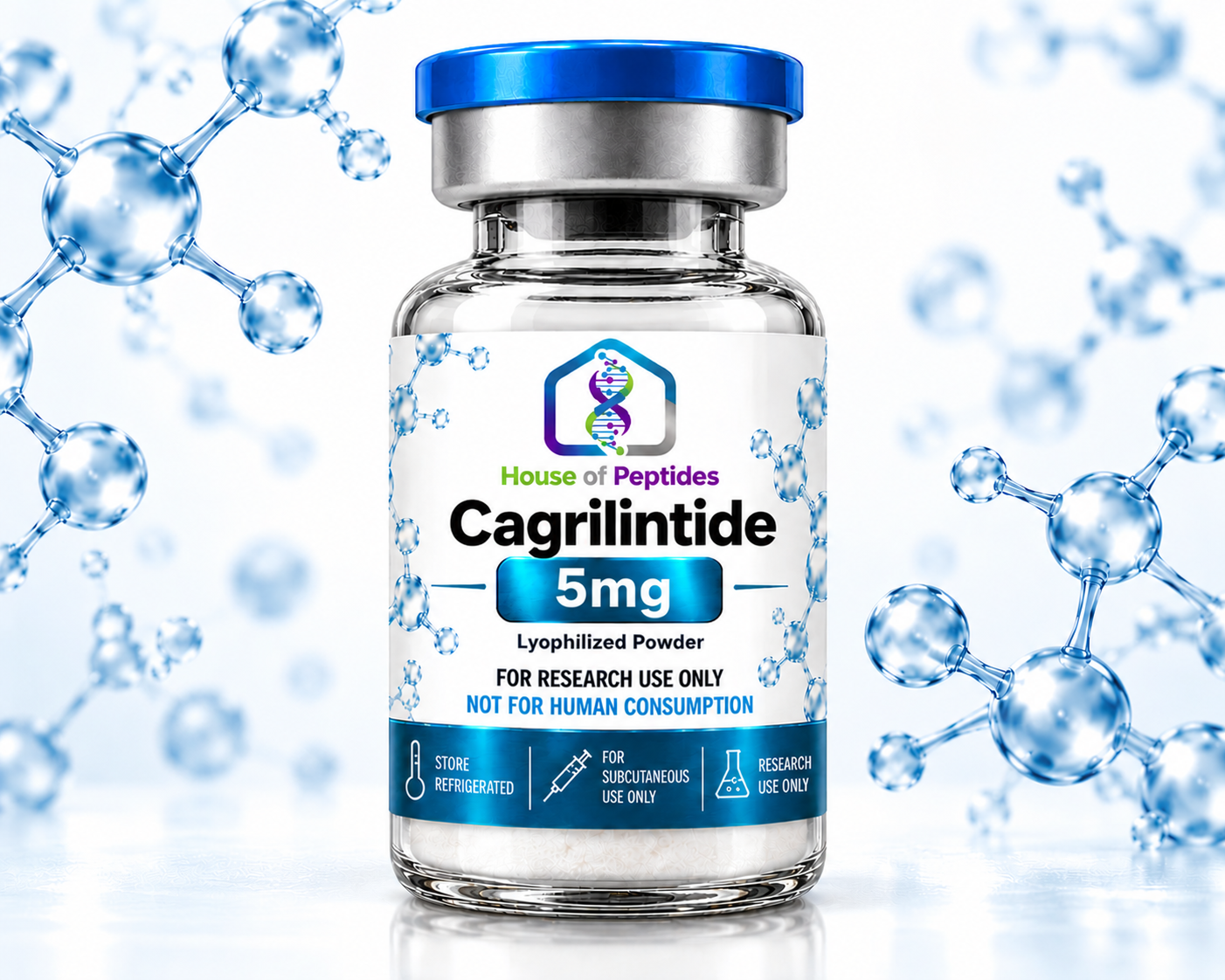
- Product: Cagrilintide 5mg
- Compound / formulation: Cagrilintide
- Labeled quantity / volume: 5mg per vial
- Physical form: White lyophilized powder
- Research focus: Metabolic Research, Amylin Signaling, Appetite Regulation, Energy Balance
- Available batch identifiers: Blue cap (active batch; COA link pending reconciliation); pink cap / green collar, batch CAG5-0703
- SKU: HOP-cagrilintide-5mg
- Intended classification: Laboratory research only
Independent Laboratory Testing
Blue cap — active batch
The corresponding COA link is pending reconciliation.
Pink cap / green collar — Janoshik, report #206281 — Batch CAG5-0703
- Compound reported: Cagrilintide
- Measured content: 5.48mg
- Purity: 99.569%
- Test date: July 27, 2026
- Verification key: 1P779JBXJEZA
- View laboratory report
House of Peptides maintains an established testing and sampling protocol with its suppliers. Under this agreed protocol, samples are randomly selected from a production batch and submitted for independent laboratory analysis.
The submitted samples are drawn from the same production batch as the corresponding inventory supplied to House of Peptides. This batch-based sampling approach provides analytical information associated with the production batch rather than individual testing of every vial.
House of Peptides may maintain inventory from multiple production batches of the same compound. Each Certificate of Analysis corresponds to its identified batch, which may be distinguished by cap color or lot designation. Orders are fulfilled on a first-in, first-out (FIFO) basis, so the batch supplied depends on available inventory at the time of fulfillment. Laboratory findings apply to the submitted samples from their respective batches, not to every individual vial.
Scientific Research Background
Cagrilintide is an investigational peptide designed to act like amylin, a hormone that helps regulate appetite and the feeling of fullness after eating.
Amylin works alongside other hormones involved in digestion and metabolism. Researchers are studying whether activating this pathway can influence food intake and body weight.
Clinical studies have investigated cagrilintide on its own and in combination with other investigational or pharmaceutical compounds.
These findings relate to the specific materials and conditions studied. They do not establish equivalent results for independently sourced research products.
Compound details
- Research classification: Long-acting amylin analogue
Clinical Research Observations
1. Why are researchers interested in cagrilintide?
Cagrilintide is an investigational long-acting analogue of amylin, a hormone involved in signaling fullness after eating.
What researchers found: Studies have examined how activating amylin-related pathways affects food intake and body-weight measurements.
Why it matters: Amylin signaling provides a different area of investigation from the GLP-1 pathway.
2. What have human studies found about body weight?
Researchers have evaluated cagrilintide in adults with overweight or obesity.
What researchers found: In a 26-week study involving more than 700 adults, average body-weight reductions ranged from 6.0% to 10.8% in cagrilintide groups, compared with 3.0% in the placebo group.
Why it matters: These findings support further investigation of amylin signaling but do not predict outcomes for individuals or independently sourced research products.
3. What adverse effects have researchers monitored?
Researchers track how people feel alongside changes in weight and other measurements.
What researchers found: Digestive side effects, including nausea and constipation, were reported during clinical studies.
Why it matters: Adverse-event findings are necessary to interpret the overall evidence, rather than focusing only on body-weight changes.
4. What about studies combining cagrilintide with semaglutide?
Scientists have also studied cagrilintide alongside a GLP-1 receptor agonist.
What researchers found: Combination studies evaluate the effects of two compounds administered together.
Why it matters: Their results cannot be attributed to cagrilintide alone or applied directly to House of Peptides' research vial.
Published Scientific Research
Lau et al. (2021)
Once-weekly cagrilintide for weight management in people with overweight and obesity: a multicentre, randomised, double-blind, placebo-controlled and active-controlled, dose-finding phase 2 trial.
The Lancet, 398(10317), 2160–2172.
https://doi.org/10.1016/S0140-6736(21)01751-7
Garvey et al. (2025)
Coadministered Cagrilintide and Semaglutide in Adults with Overweight or Obesity.
The New England Journal of Medicine, 393, 635–647.
https://doi.org/10.1056/NEJMoa2502081
These publications concern investigational materials evaluated under controlled clinical-trial protocols. The second study evaluated cagrilintide in combination with semaglutide, not as a standalone research product.
Their findings do not establish the safety, effectiveness, or clinical equivalence of the Cagrilintide 5mg research product offered by House of Peptides.
Understanding the Research Findings
Janoshik Report #206281 reports analytical findings for the submitted Cagrilintide sample, batch CAG5-0703. These findings apply to that submitted sample and do not establish the analytical status of every vial.
The research findings above concern the specific investigational materials studied. They do not establish clinical outcomes, safety, or pharmaceutical equivalence for House of Peptides’ Cagrilintide 5mg. The research product is not FDA-approved or represented as equivalent to materials used in published studies.
House of Peptides does not claim affiliation with or endorsement by the developers referenced in the research.
Research Use Notice
For laboratory research only. Not intended for human or veterinary administration, diagnostic, or therapeutic use.


Reviews
There are no reviews yet.