Description
Product Specifications
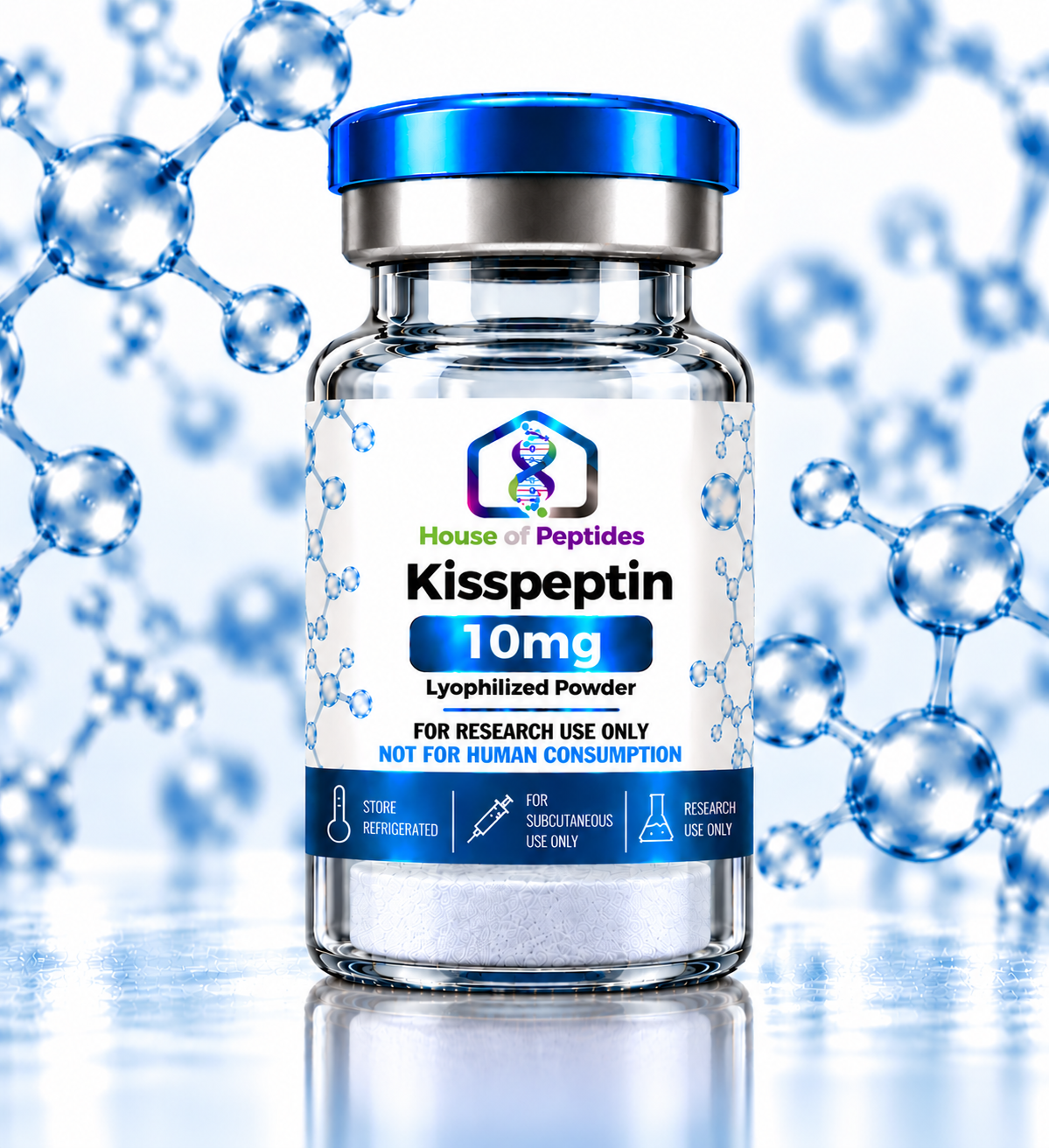
- Product: Kisspeptin 10mg
- Compound / formulation: Kisspeptin-10
- Labeled quantity / volume: 10mg per vial
- Physical form: White lyophilized powder
- Research focus: Reproductive Hormone Research, Neuroendocrine Signaling, GnRH Research
- Available batch identifiers: Green cap, batch KS10-0903
- SKU: HOP-KISSPEPTIN-10MG
- Intended classification: Laboratory research only
Independent Laboratory Testing
Green cap — Janoshik Analytical, report #235045 — Batch KS10-0903
- Compound reported: Kisspeptin 10mg
- Measured content: 11.69mg
- Purity: 99.918%
- Test date: September 30, 2026
- View laboratory report
House of Peptides maintains an established testing and sampling protocol with its suppliers. Under this agreed protocol, samples are randomly selected from a production batch and submitted for independent laboratory analysis.
The submitted samples are drawn from the same production batch as the corresponding inventory supplied to House of Peptides. This batch-based sampling approach provides analytical information associated with the production batch rather than individual testing of every vial.
House of Peptides may maintain inventory from multiple production batches of the same compound. Each Certificate of Analysis corresponds to its identified batch, which may be distinguished by cap color or lot designation. Orders are fulfilled on a first-in, first-out (FIFO) basis, so the batch supplied depends on available inventory at the time of fulfillment. Laboratory findings apply to the submitted samples from their respective batches, not to every individual vial.
Scientific Research Background
Kisspeptin is a naturally occurring signaling molecule that helps regulate reproductive hormones.
It acts within the communication system connecting the brain, pituitary gland, and reproductive organs. When kisspeptin activates this system, it can stimulate the release of hormones that help regulate testosterone production, ovarian function, and other reproductive processes.
Researchers study kisspeptin because it helps explain how reproductive hormone signals begin, how they change over time, and why those responses may differ between men and women.
Human studies have investigated kisspeptin-10 and other forms of kisspeptin. Findings involving one form should not automatically be assumed to apply identically to another.
Compound details
- Research classification: Reproductive hormone signaling peptide
- Research pathway: Kisspeptin receptor / GnRH signaling
Clinical Research Observations
Researchers have studied kisspeptin to understand how the brain helps control reproductive hormones and why those signals are important for normal reproductive function.
1. How does kisspeptin influence reproductive hormone signaling?
The brain and reproductive organs communicate through hormone signals.
What researchers found: In studies involving healthy men, researchers found that kisspeptin-10 stimulated the release of hormones that help regulate testosterone production.
Why it matters: These findings helped scientists better understand how the brain communicates with the reproductive system and influences hormone activity. Hormone changes in studies do not establish benefits for independently sourced products.
2. What have studies found about the female reproductive cycle?
Hormone activity changes during the menstrual cycle.
What researchers found: Researchers have also studied kisspeptin in women to understand its role in the menstrual cycle.
They found that the body's response to kisspeptin can change depending on the stage of the cycle. Certain hormonal responses were stronger near ovulation, when the body prepares to release an egg.
This helped researchers understand why reproductive hormone signaling changes throughout the month.
Why it matters: Research findings depend on the participants and study design.
3. What happens when kisspeptin exposure is repeated?
A response to one exposure may differ from a response repeated over several days.
What researchers found: Researchers have investigated whether kisspeptin continues to stimulate reproductive hormones when exposure is repeated over several days.
In a study involving healthy men, certain patterns of kisspeptin-10 exposure continued to produce hormonal responses over a 12-day period.
These findings help scientists explore how the reproductive hormone system adapts to repeated stimulation.
Why it matters: Repeated exposure can produce different responses in the body from a single exposure.
4. What is the overall scientific takeaway?
Researchers consider the form of kisspeptin and the people studied when interpreting results.
What researchers found: Human studies have shown that kisspeptin plays an important role in the communication between the brain and the reproductive system.
Scientists continue to investigate how this signaling pathway influences reproductive hormone regulation and why responses differ between individuals.
The findings come from controlled studies using specific research preparations. They do not establish equivalent effects or safety for independently sourced kisspeptin products.
Why it matters: Human findings must not be generalized beyond the tested preparation and population.
Published Scientific Research
George et al. (2011) — Kisspeptin-10 Is a Potent Stimulator of LH and Increases Pulse Frequency in Men. A human study examining reproductive hormone responses to kisspeptin-10. https://pubmed.ncbi.nlm.nih.gov/21632807/
Chan et al. (2012) — Kisspeptin Administration to Women: A Window into Endogenous Kisspeptin Secretion and GnRH Responsiveness Across the Menstrual Cycle. Research examining how hormonal responses differ across menstrual-cycle phases. https://pubmed.ncbi.nlm.nih.gov/22577171/
Yeung et al. (2026) — Chronic Subcutaneous Kisspeptin-10 Stimulates Gonadotropin Secretion for 12 Days in Healthy Men. Research investigating sustained hormonal responses under different exposure patterns. https://pubmed.ncbi.nlm.nih.gov/42549827/
Understanding the Research Findings
Published human research provides evidence that kisspeptin-10 influences reproductive hormone signaling under controlled experimental conditions.
These studies help explain how the brain regulates reproductive hormones, but they do not establish that kisspeptin improves libido, fertility, testosterone levels, or other health outcomes when used outside the specific research settings investigated.
The independent laboratory report for the House of Peptides batch provides analytical information about the submitted sample's peptide quantity and purity. It does not establish sterility, safety for administration, pharmaceutical equivalence, or clinical effectiveness.
House of Peptides Kisspeptin 10mg is an independently sourced laboratory research material, not an FDA-approved medication.
Research Use Notice
For laboratory research only. Not intended for human or veterinary administration, diagnostic, or therapeutic use.


Reviews
There are no reviews yet.