
Description
Product Specifications
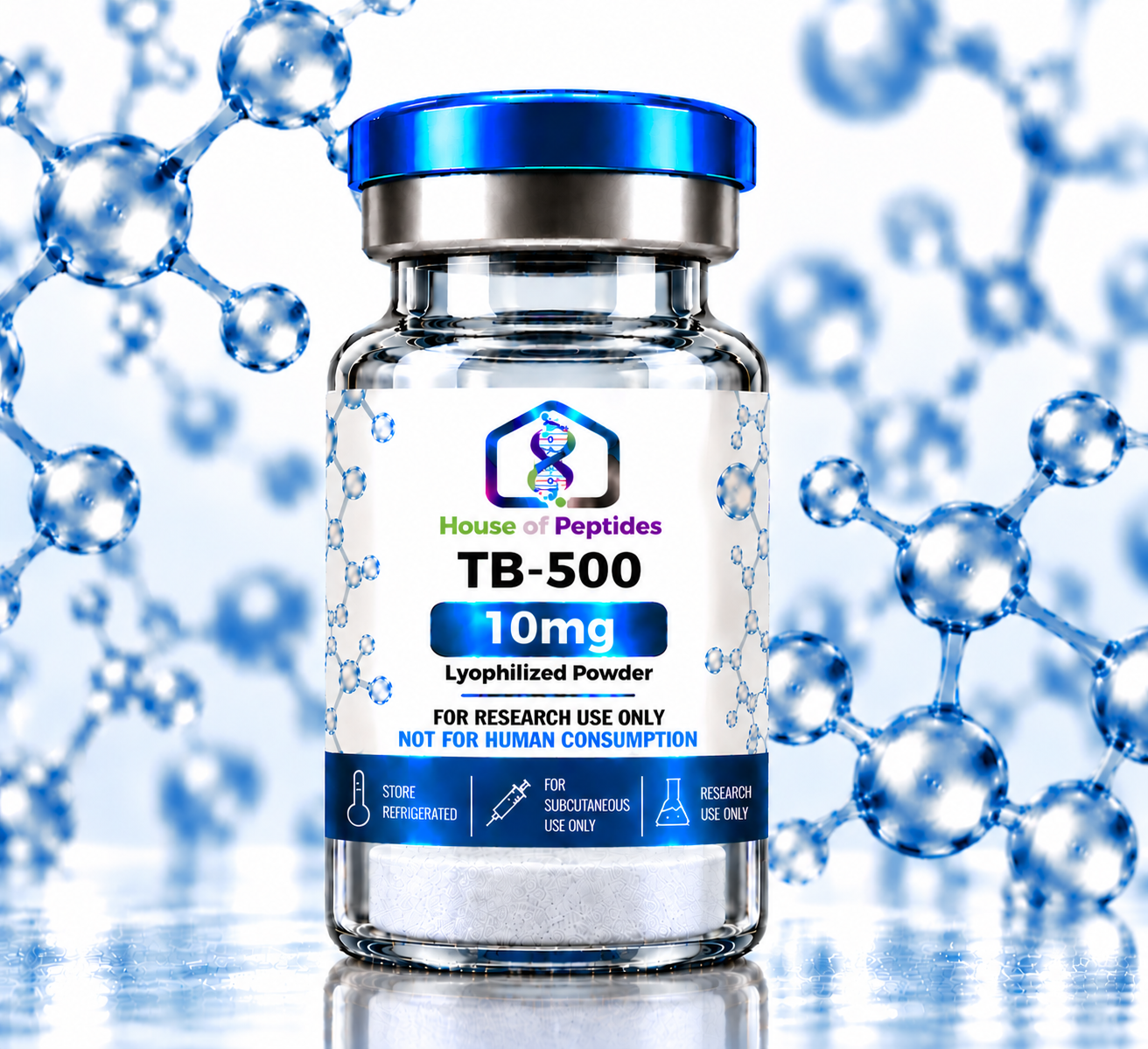
- Product: TB-500 10mg
- Compound / formulation: TB-500
- Labeled quantity / volume: 10mg per vial
- Physical form: White lyophilized powder
- Research focus: Cell Migration Research; Tissue Biology Research; Inflammatory Signaling
- Available batch identifiers: Pink cap, batch TB410-0606; Yellow Cap (Freedom Diagnostics)
- SKU: HOP-tb-500-10mg
- Intended classification: Laboratory research only
Independent Laboratory Testing
House of Peptides maintains an established testing and sampling protocol with its suppliers. Under this agreed protocol, samples are randomly selected from a production batch and submitted for independent laboratory analysis.
The submitted samples are drawn from the same production batch as the corresponding inventory supplied to House of Peptides. This batch-based sampling approach provides analytical information associated with the production batch rather than individual testing of every vial.
House of Peptides may maintain inventory from multiple production batches of the same compound. Each Certificate of Analysis corresponds to its identified batch, which may be distinguished by cap color or lot designation. Orders are fulfilled on a first-in, first-out (FIFO) basis, so the batch supplied depends on available inventory at the time of fulfillment. Laboratory findings apply to the submitted samples from their respective batches, not to every individual vial.
Janoshik Analytical — Report #197395
- Batch / cap identifier: TB410-0606 / Pink cap
- Reported result: TB-500 (TB-4), 11.77 mg
- Purity: 99.119%
- Analysis conducted: July 1, 2026
Freedom Diagnostics — PEPE2608130675
- Lot / cap identifier: Yellow Cap
- Identity (LC-MS): Thymosin Beta-4
- Net content: 13.90 mg
- Purity (HPLC-UV): 99.21%
- Received: August 13, 2026
- Reported: August 18, 2026
Scientific Research Background
Thymosin beta-4 is a naturally occurring peptide studied for its relationship with actin, a protein that helps cells maintain their shape and move. Cell movement and organization are important in normal tissue maintenance and in experimental models of injury.
The term TB-500 is used commercially for peptide materials associated with thymosin beta-4, but it does not always identify a single confirmed amino-acid sequence. Some materials described as TB-500 may differ from full-length thymosin beta-4. Without sequence-specific analytical documentation for this vial, the two should not be treated as chemically or biologically interchangeable.
Published work on thymosin beta-4 includes laboratory and animal investigations of cell movement, corneal tissue responses, inflammatory signaling, and extracellular matrix processes. These studies explain the scientific interest in this research area; they do not demonstrate the effects, safety, or clinical effectiveness of this specific TB-500 product.
Compound details
- Research classification: Peptide research material
Clinical Research Observations
Researchers have investigated full-length thymosin beta-4 in laboratory experiments and animal models to understand how cells move and how injured tissues respond. The following observations are scientific context for TB-500-related research, not direct testing of the standalone TB-500 10mg vial. The distinction between the studied molecule and the supplied material is essential.
1. What have thymosin beta-4 studies shown about tissue repair?
Researchers have studied the protective surface of the eye after experimental injury.
What researchers found: In a study involving mice with experimentally injured corneas—the clear outer surface of the eye—researchers observed that tissues treated with Thymosin Beta-4 restored their protective surface more quickly than untreated tissues.
The researchers also reported fewer inflammatory cells in the affected area.
These observations have contributed to scientific interest in how Thymosin Beta-4 interacts with cells involved in tissue repair and maintenance.
Why it matters: Corneal repair in mice does not establish effects in other tissues or in humans. The findings also cannot automatically be attributed to a TB-500 material without confirming that it has the same molecular structure.
2. Why is thymosin beta-4 studied in cell movement and tissue organization?
Cell shape and movement are part of how tissues maintain their organization.
What researchers found: Laboratory investigations have examined how thymosin beta-4 interacts with actin, a protein involved in cell shape and movement. Researchers have studied these cellular processes to understand how cells reorganize and move in experimental tissue models.
These mechanistic observations help explain scientific interest in thymosin beta-4's relationship to tissue maintenance, but they do not establish that every product described as TB-500 behaves identically.
Why it matters: Observations about actin and cell movement are findings about how cells work, not proof of tissue-repair outcomes or clinical benefit in people.
3. What can researchers conclude from thymosin beta-4 findings about TB-500?
The name on a research product does not by itself establish its complete molecular structure.
What researchers found: Some blend reports identify Thymosin Beta-4, while others use the label TB-500 (TB4) without specifying its complete sequence. The associated scientific observations concern thymosin beta-4 studied under particular experimental conditions.
The Thymosin Beta-4 findings cannot automatically be attributed to TB-500 material without confirming that the tested compounds have the same molecular structure.
Why it matters: Shared terminology or inclusion in related blends does not establish chemical equivalence, identical biological activity, or human safety and efficacy for the standalone TB-500 10mg product.
4. Has this standalone TB-500 10mg material been independently characterized?
A published biological study and a laboratory report about a particular vial provide different information.
What researchers found: Published studies of thymosin beta-4 and related peptides describe specific experimental materials and methods. Results from those materials do not establish the analytical characteristics of a different standalone research vial.
Why it matters: Research findings must be interpreted in relation to the exact compound and preparation investigated.
Published Scientific Research
- Sosne et al. (2002) — Thymosin Beta 4 Promotes Corneal Wound Healing and Decreases Inflammation In Vivo Following Alkali Injury. Experimental Eye Research. https://doi.org/10.1006/exer.2001.1125 — Animal research involving thymosin beta-4 and corneal tissue responses. This reference is also used in the approved GLOW and KLOW pages; it does not establish identity or effects of the TB-500 vial.
Understanding the Research Findings
The research described here concerns thymosin beta-4, a defined peptide studied in laboratory and animal models. The designation TB-500 on a commercial research vial does not by itself confirm that the material has the same molecular sequence as full-length thymosin beta-4.
Findings about cell migration, tissue organization, or inflammatory responses should therefore be understood as related scientific context—not direct evidence of the properties of the exact TB-500 10mg material. No human safety or efficacy claims are made.
Research Use Notice
For laboratory research only. Not intended for human or veterinary administration, diagnostic, or therapeutic use.

Reviews
There are no reviews yet.