Description
Product Specifications
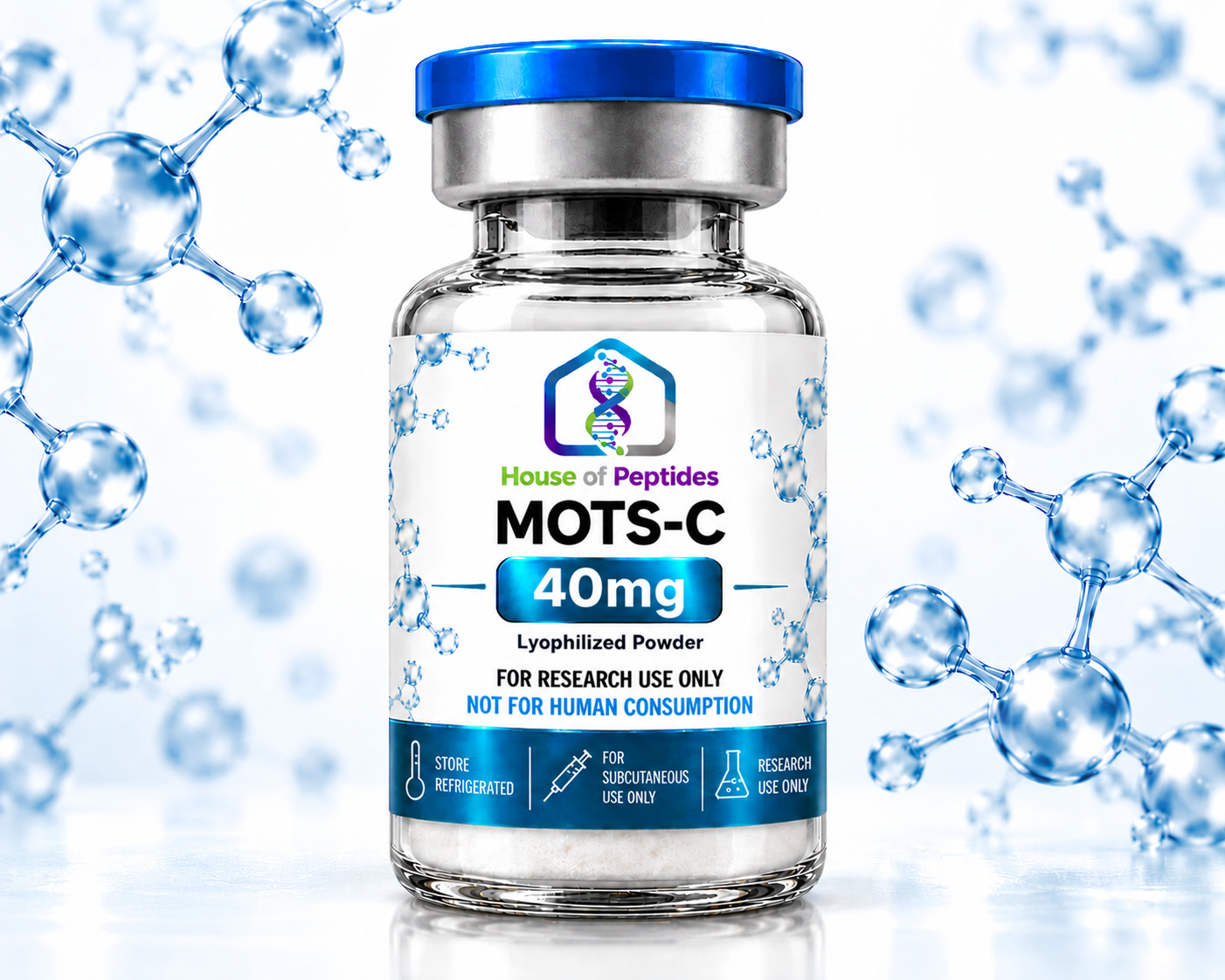
- Product: MOTS-C 40mg
- Compound / formulation: MOTS-c (mitochondrial-derived peptide)
- Labeled quantity / volume: 40mg per vial
- Physical form: White lyophilized powder
- Research focus: Mitochondrial Research, Metabolic Research, Cellular Stress Response, Energy Regulation
- Available batch identifiers: White cap (MS40-2607-001); dark-green cap (PROBIOS-MS40-0726)
- SKU: HOP-mots-c-40mg
- Intended classification: Laboratory research only
Independent Laboratory Testing
White cap — Janoshik Analytical, report #212724 — Batch MS40-2607-001
- Compound reported: MOTS-C
- Measured content: 45.33mg
- Purity: 99.278%
- Test date: July 31, 2026
- View laboratory report
Dark-green cap — Vanguard Laboratory — Lot PROBIOS-MS40-0726
- Identity reported: HPLC-UV/VIS: matches reference standard
- Measured content: 46.01mg
- Purity: 98.97% ± 0.18%
- Report date: August 3, 2026
- View laboratory report
House of Peptides maintains an established testing and sampling protocol with its suppliers. Under this agreed protocol, samples are randomly selected from a production batch and submitted for independent laboratory analysis.
The submitted samples are drawn from the same production batch as the corresponding inventory supplied to House of Peptides. This batch-based sampling approach provides analytical information associated with the production batch rather than individual testing of every vial.
House of Peptides may maintain inventory from multiple production batches of the same compound. Each Certificate of Analysis corresponds to its identified batch, which may be distinguished by cap color or lot designation. Orders are fulfilled on a first-in, first-out (FIFO) basis, so the batch supplied depends on available inventory at the time of fulfillment. Laboratory findings apply to the submitted samples from their respective batches, not to every individual vial.
Scientific Research Background
Mitochondria are structures inside cells that help turn nutrients into energy. They also take part in communication within the cell.
MOTS-c is a naturally occurring peptide made from 16 amino acids. Its genetic instructions come from mitochondrial DNA. Scientists study how it relates to energy use and communication between different parts of a cell.
Laboratory research has linked MOTS-c activity with changes in cellular chemical processes and AMPK, a protein involved in managing energy balance. Animal studies have examined insulin responses, muscle function, exercise, and aging.
Human observations have also measured the body's own MOTS-c during exercise. Measuring a naturally occurring peptide in people is different from testing an additional supply of that peptide. Most evidence about administered MOTS-c comes from cells and animals, and does not establish human benefits or long-term safety.
Compound details
- Peptide length: 16 amino acids
- Research classification: Mitochondrial-derived peptide; metabolic signaling research
Clinical Research Observations
Researchers are studying MOTS-C to better understand how cells manage energy and respond to physical and metabolic stress.
1. What have researchers found about MOTS-C and metabolism?
Researchers study how the body responds to insulin and uses nutrients for energy.
What researchers found: In a 2015 study, researchers found that mice receiving MOTS-c showed improved responses to insulin. Mice fed a high-fat diet also gained less weight than untreated animals, despite consuming similar amounts of food.
These findings attracted interest in MOTS-c's role in how the body processes and uses energy.
Why it matters: Mouse metabolic findings do not establish comparable human outcomes.
2. How is MOTS-C connected to exercise research?
Exercise changes the demands placed on muscles. Researchers have studied MOTS-C alongside these changes.
What researchers found: A 2021 study found that mice receiving MOTS-c performed better in exercise tests, including older mice.
The researchers also studied healthy human volunteers and found that exercise increased the amount of MOTS-c naturally present in their muscles and bloodstream.
This suggests a connection between the body's own MOTS-c production and physical activity, although the human study did not test administered MOTS-c.
Why it matters: Natural MOTS-C increases during human exercise do not demonstrate effects from administering the peptide.
3. What is the overall evidence for MOTS-C?
Findings from cells, animals, and human observations answer different research questions.
What researchers found: Laboratory and animal studies suggest that MOTS-C may influence how the body uses glucose and responds to changes in energy demand. These findings have made it an area of interest in metabolism and mitochondrial research.
However, most of the available evidence comes from early-stage experiments. Researchers have not established whether these findings translate into meaningful benefits in humans, and human safety data remain limited.
Why it matters: Early-stage results support further investigation, not established human benefits.
Published Scientific Research
- Lee et al. (2015), The Mitochondrial-Derived Peptide MOTS-c Promotes Metabolic Homeostasis and Reduces Obesity and Insulin Resistance, Cell Metabolism. https://doi.org/10.1016/j.cmet.2015.02.009
- Reynolds et al. (2021), MOTS-c Is an Exercise-Induced Mitochondrial-Encoded Regulator of Age-Dependent Physical Decline and Muscle Homeostasis, Nature Communications. https://doi.org/10.1038/s41467-020-20790-0
- Lee, Kim, and Cohen (2016), MOTS-c: A Novel Mitochondrial-Derived Peptide Regulating Muscle and Fat Metabolism, Free Radical Biology and Medicine. https://doi.org/10.1016/j.freeradbiomed.2016.05.015
Kim et al. (2018) — The Mitochondrial-Encoded Peptide MOTS-c Translocates to the Nucleus to Regulate Nuclear Gene Expression in Response to Metabolic Stress. Cell Metabolism. Primary cell experiments supporting the nuclear gene-regulation background; not human administration evidence. https://pubmed.ncbi.nlm.nih.gov/29983246/ DOI: 10.1016/j.cmet.2018.06.008.
Understanding the Research Findings
The published studies describe MOTS-c biology in specific experimental settings. Findings involving naturally produced MOTS-c in humans, or synthetic material used in laboratory and animal studies, should not be interpreted as evidence that House of Peptides' MOTS-C 40mg product has been clinically evaluated.
The published research examines MOTS-c in laboratory, animal, and limited human observational settings. These findings do not establish clinical effects for this research product. MOTS-c is not an FDA-approved drug ingredient for clinical use.
Research Use Notice
For laboratory research only. Not intended for human or veterinary administration, diagnostic, or therapeutic use.



Reviews
There are no reviews yet.