
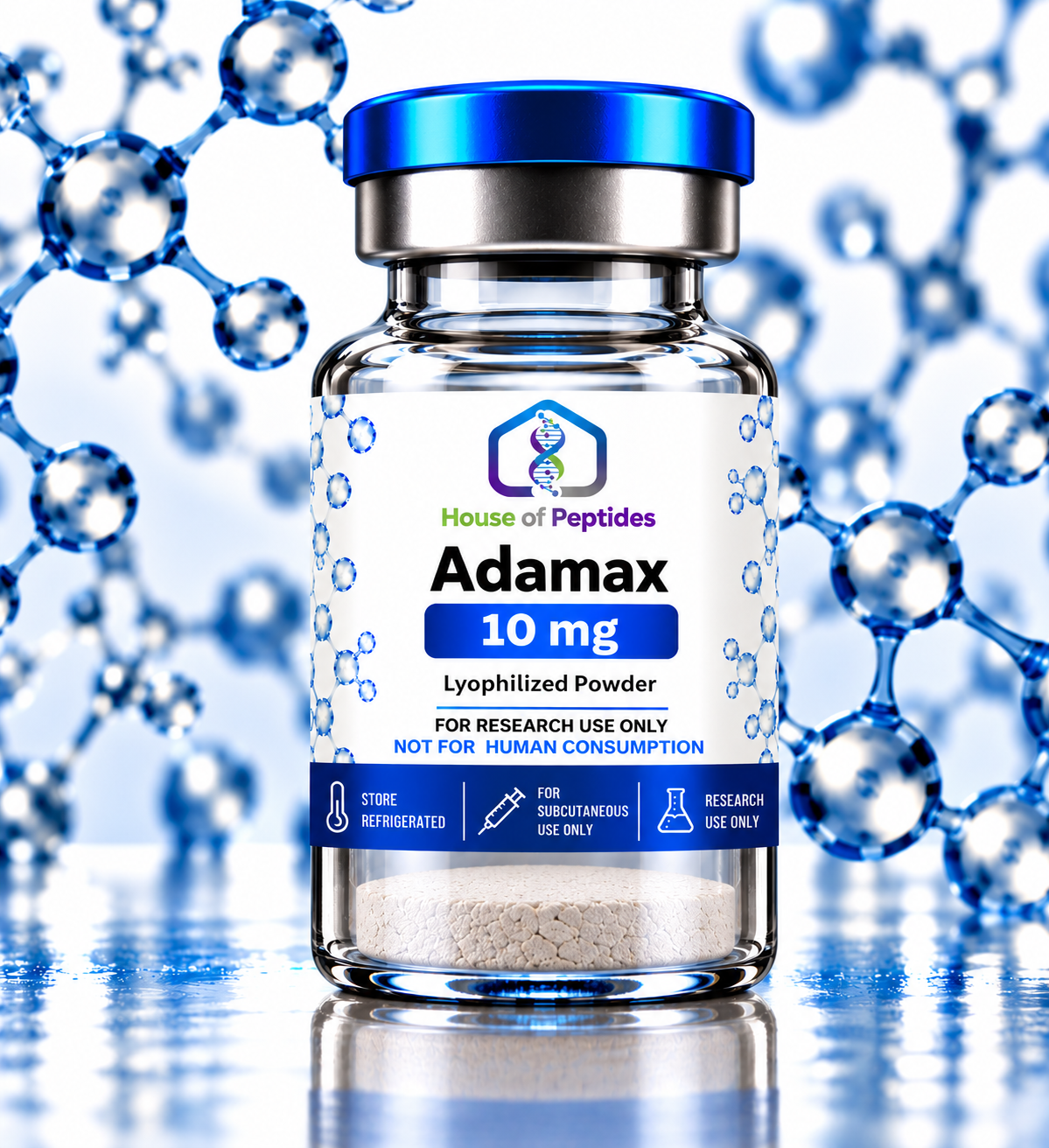
Description
Product Specifications
- Product: Adamax 10mg
- Compound / formulation: Adamax
- Labeled quantity / volume: 10mg per vial
- Physical form: White lyophilized powder
- Research focus: Semax derivatives and peptide modification
- Available batch identifiers: Pink cap
- SKU: HOP-ADAMAX-10MG
- Intended classification: Laboratory research only
Independent Laboratory Testing
Chromate Laboratory, report #40383
- Compound reported: Adamax
- Measured content: 9.847mg
- Purity: 99.042%
- Test date: October 1, 2026
- View laboratory report
House of Peptides maintains an established testing and sampling protocol with its suppliers. Under this agreed protocol, samples are randomly selected from a production batch and submitted for independent laboratory analysis.
The submitted samples are drawn from the same production batch as the corresponding inventory supplied to House of Peptides. This batch-based sampling approach provides analytical information associated with the production batch rather than individual testing of every vial.
House of Peptides may maintain inventory from multiple production batches of the same compound. Each Certificate of Analysis corresponds to its identified batch, which may be distinguished by cap color or lot designation. Orders are fulfilled on a first-in, first-out (FIFO) basis, so the batch supplied depends on available inventory at the time of fulfillment. Laboratory findings apply to the submitted samples from their respective batches, not to every individual vial.
Scientific Research Background
Semax is a synthetic peptide made from seven amino acids. Researchers have investigated its effects on nerve-cell signaling in animals and brain-network measurements in people.
Adamax is described as a Semax derivative with an attached adamantane group. This addition changes the peptide’s chemical structure, giving it a bulky, rigid region with a strong preference for fat-like environments. The term for this preference is lipophilicity.
That property matters because cell membranes contain lipid-rich regions. Adding a lipophilic group can change how a molecule associates with membranes and proteins, making its distribution a relevant research question.
The group’s size also matters. In peptide design, a bulky modification can make some sites less accessible to enzymes that break peptide bonds. Experiments with other adamantane-modified peptides have demonstrated increased resistance to breakdown in human serum under laboratory conditions.
These are the reasons the modification is significant: it provides a way to investigate changes in peptide stability and delivery while retaining a structural relationship to Semax. The Semax portion provides the starting structure; the added adamantane group introduces different chemical properties.
For Adamax, the extent of any change in breakdown, brain entry, or duration of activity still requires direct measurement. Findings about Semax or other modified peptides do not supply those measurements.
Clinical Research Observations
These observations explain research on Semax and peptide modification. Each finding identifies what was tested. The results do not show that Adamax produces the same effects.
1. What has Semax research shown about nerve cells?
Nerve cells respond to proteins that help support their function. One of these proteins is called brain-derived neurotrophic factor, or BDNF.
Researchers have studied whether Semax affects this protein and the signals linked to it.
What researchers found: A 2006 study of Semax in rats reported more BDNF and changes in related signals in a brain region involved in learning and memory.
Why it matters: These findings give scientists clues about how Semax affects nerve cells. They do not show that Adamax has the same effects or improves memory in people.
2. What have human brain scans shown?
Brain scans let researchers study patterns across connected brain areas, including when a person is resting.
A change on a scan does not necessarily mean someone performs better in everyday tasks.
What researchers found: A 2018 study of Semax in 24 healthy volunteers reported different scan patterns in part of a resting brain network compared with placebo.
Why it matters: The study helps researchers investigate how Semax affects brain networks. It did not test Adamax or establish better focus, memory, or learning.
3. Why does the adamantane modification matter?
Adamantane adds a bulky region that favors fat-like environments. Researchers study whether these features change how a peptide interacts with cell membranes and with enzymes that break it down.
What researchers found: In a 2008 laboratory study, peptides with an adamantane-based modification broke down more slowly in human serum—the liquid left after blood clots—and attached to proteins in that liquid. These were different peptides, not Semax or Adamax. A separate Semax patent describes stability and brain delivery as goals for proposed modifications.
Why it matters: This gives scientists an experimental reason to explore adamantane as a way to change peptide stability. It does not tell us how long Adamax lasts or how much reaches the brain.
4. Can changing Semax change what it does?
Researchers have also studied Semax with a small chemical group, called an acetyl group, added to one end.
This produces acetylated Semax, a different derivative from Adamax.
What researchers found: In a 2016 cell study, acetylated Semax interacted differently with copper and did not retain the protective effect against copper-related cell damage seen with Semax.
Why it matters: Even a small change in structure can change a peptide’s effects. Each version needs its own testing; this experiment does not tell us how Adamax behaves.
5. What is the overall scientific takeaway?
Semax research helps explain the interest in Adamax. Studies of other modified peptides help explain why scientists investigate adding an adamantane group.
What researchers found: The studies described here tested Semax or other peptides. The patent describes proposed modifications. These sources explain the research rationale, but do not show what Adamax does in people.
Why it matters: A chemical change can be worth investigating without being proven to work better. Tests with Adamax itself are needed to learn whether it lasts longer, reaches the brain more efficiently, or produces meaningful benefits. The sources reviewed do not establish its safety in people.
Published Scientific Research
These sources concern Semax, other modified peptides, and modification chemistry. None is presented as a biological study of Adamax.
Dolotov et al. (2006) — Semax and BDNF-related signaling in rats. Brain Research, 1117(1):54–60. Reported BDNF and related signaling changes in the rat hippocampus. PubMed — PMID 16996037. DOI:
10.1016/j.brainres.2006.07.108. Supports: Background; Question 1.Lebedeva et al. (2018) — Semax and resting brain-network imaging. Bulletin of Experimental Biology and Medicine, 165(5):653–656. Brain-imaging study of 24 healthy volunteers comparing Semax with placebo. PubMed — PMID 30225715. DOI:
10.1007/s10517-018-4234-3. Supports: Background; Question 2.Magrì et al. (2016) — Acetylated Semax, metal binding, and cell-model findings. Journal of Inorganic Biochemistry, 164:59–69. Examined a different Semax derivative, not Adamax. PubMed — PMID 27586814. DOI:
10.1016/j.jinorgbio.2016.08.013. Supports: Question 4.Patent application WO2023046336A1 (2023) — Semax compositions and proposed derivatives. Sections 0032–0034 describe the peptide and possible modifications, including adamantane-containing derivatives. This is proposed chemistry, not a clinical trial or proof that the stocked product matches a specific patented structure. Read patent application. Supports: Background; Question 3.
PubChem — Adamantane, CID 9238. Chemical structure record used to explain the adamantane group; not evidence of Adamax’s biological effects. View chemical record. Supports: Background.
Liu et al. (2011) — Adamantyl groups in molecular design. European Journal of Medicinal Chemistry, 46(6):1949–1963. Review and chemical-property analysis explaining lipophilicity and structural bulk across other compounds. PubMed — PMID 21354674. DOI:
10.1016/j.ejmech.2011.01.047. Supports: Short description; Background; Question 3. Not an Adamax experiment.Roščić et al. (2008) — Stability of adamantane-modified peptide analogues. Croatica Chemica Acta, 81(4):637–640. Laboratory study of methionine-enkephalin analogues in human serum; examined peptide breakdown and serum-protein binding. Journal record; Published paper. Supports: Background; Question 3. Tested different peptides, not Semax or Adamax.
Understanding the Research Findings
Semax research provides background for Adamax’s relationship to this peptide family. The adamantane modification introduces a separate question about how the altered structure behaves.
Published findings about Semax, proposed chemical advantages, and laboratory measurements of an Adamax sample are different kinds of information. They cannot be combined into proof that this research product improves cognition or provides the same effects as Semax.
Research Use Notice
For laboratory research only. Not intended for human or veterinary administration, diagnostic, or therapeutic use.


Reviews
There are no reviews yet.