Description
Product Specifications
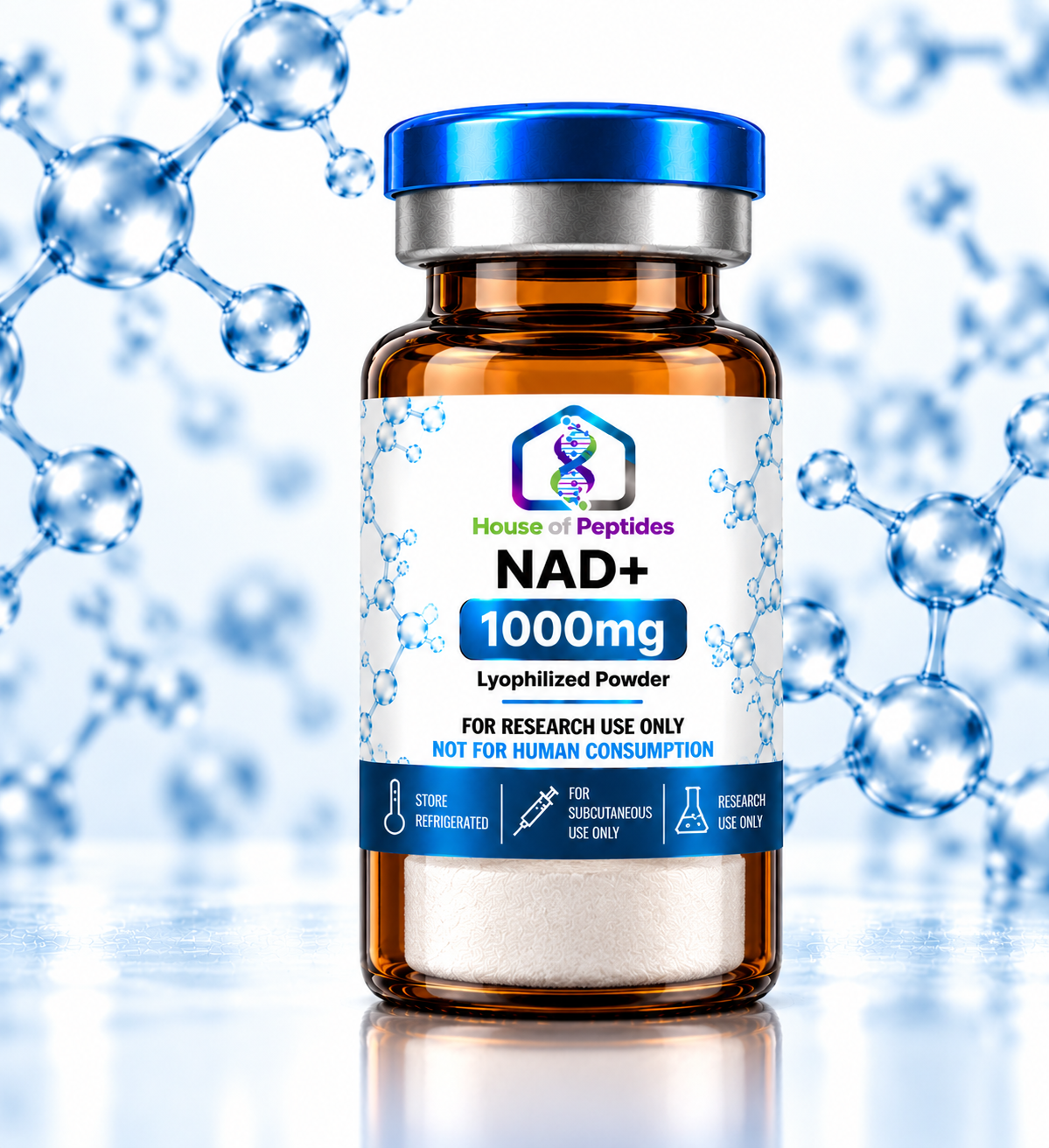
- Product: NAD+ 1000mg
- Compound / formulation: Nicotinamide Adenine Dinucleotide
- Labeled quantity / volume: 1000mg
- Physical form: White lyophilized powder
- Research focus: Energy, Youth & Longevity Research
- Available batch identifiers: Black
- SKU: HOP-NAD-1000MG
- Intended classification: Laboratory research use only
Independent Laboratory Testing
Black cap — Freedom Diagnostics, accession 2607150833
- Compound reported: NAD+ confirmed
- Measured content, vial 1: 1096.66mg
- Purity, vial 1: 99.65%
- Measured content, vial 2: 1086.16mg
- Purity, vial 2: 99.66%
- Average measured content: 1091.41mg
- Report date: July 18, 2026
- View laboratory report
House of Peptides maintains an established testing and sampling protocol with its suppliers. Under this agreed protocol, samples are randomly selected from a production batch and submitted for independent laboratory analysis.
The submitted samples are drawn from the same production batch as the corresponding inventory supplied to House of Peptides. This batch-based sampling approach provides analytical information associated with the production batch rather than individual testing of every vial.
House of Peptides may maintain inventory from multiple production batches of the same compound. Each Certificate of Analysis corresponds to its identified batch, which may be distinguished by cap color or lot designation. Orders are fulfilled on a first-in, first-out (FIFO) basis, so the batch supplied depends on available inventory at the time of fulfillment. Laboratory findings apply to the submitted samples from their respective batches, not to every individual vial.
Scientific Research Background
NAD+ is a coenzyme, meaning it helps other molecules carry out important chemical reactions inside cells.
One of its best-understood functions is helping cells convert nutrients into usable energy. NAD+ also participates in processes that help cells respond to stress and maintain their normal functions.
Researchers are particularly interested in NAD+ because it is used by proteins involved in DNA repair and cellular regulation.
Scientists have also investigated how NAD+ levels change with aging. Although some studies have reported lower NAD+ levels in certain tissues or experimental conditions, the relationship between NAD+ and aging in humans remains an active area of research.
Clinical Research Observations
1. How does NAD+ relate to cellular energy?
Cells need to turn nutrients into energy. NAD+ participates in that process.
What researchers found: NAD+ plays an essential role in how cells turn nutrients into energy.
Researchers have studied what happens when NAD+ levels change and how those changes affect normal cell function.
Why it matters: These studies help explain why NAD+ is important to cellular health. However, they have not established that taking additional NAD+ increases energy or improves physical performance. NAD+ is essential to cellular biology, but this does not establish benefits from a specific research product.
2. Why is NAD+ studied in cellular repair?
Cells continually maintain and repair their structures, including DNA.
What researchers found: Research shows that NAD+ is involved in several of these maintenance processes, including those associated with DNA repair.
Laboratory and animal studies have explored whether changes in NAD+ levels influence how cells respond to damage and aging.
These findings are promising areas for further investigation, but they do not establish that additional NAD+ reverses aging or prevents disease.
Why it matters: Cellular mechanisms do not prove clinical outcomes.
3. What have studies in humans found?
Researchers can measure how the body processes a substance without demonstrating a health benefit.
What researchers found: Human research involving NAD+ itself is still limited.
In one small study, researchers followed changes in NAD+ levels and related compounds in blood and urine during a controlled NAD+ infusion.
The findings helped researchers better understand how the body processes NAD+.
this study did not demonstrate improvements in energy, longevity, mental performance, or overall health.
Why it matters: Human study results depend on the preparation and outcome measured.
4. What questions remain unanswered about NAD+?
Related compounds can answer different questions from research on NAD+ itself.
What researchers found: Scientists are also studying compounds called NR and NMN, which the body can use to produce NAD+.
Although these studies provide useful information, NR and NMN are different substances from NAD+ itself.
Researchers still need stronger human evidence to determine whether increasing NAD+ produces meaningful health benefits.
Why it matters: Further research is needed to establish meaningful benefits and safety for specific interventions.
Published Scientific Research
Migaud, Ziegler & Baur (2024) — Regulation of and challenges in targeting NAD+ metabolism. Nature Reviews Molecular Cell Biology.
A scientific review explaining NAD+'s roles in metabolism, cellular regulation, and the challenges involved in studying ways to alter NAD+ levels.
Grant et al. (2019) — A Pilot Study Investigating Changes in the Human Plasma and Urine NAD+ Metabolome During a 6 Hour Intravenous Infusion of NAD+.
A small human study examining changes in NAD+ and related substances during and after controlled administration. Its findings concern NAD+ metabolism rather than demonstrated therapeutic benefits.
Vinten et al. (2025) — NAD+ precursor supplementation in human ageing: clinical evidence and challenges. Nature Metabolism.
A review examining human research on compounds used to increase NAD+ availability, including important limitations in the evidence for benefits related to aging.
Understanding the Research Findings
NAD+ is essential to normal cellular function, and its role in energy metabolism and cellular maintenance is well established.
However, understanding what NAD+ does naturally inside cells is different from demonstrating that administering additional NAD+ produces a specific benefit.
Research involving cells, animals, and NAD+ precursors provides useful scientific information, but those findings cannot automatically be applied to this NAD+ product or to human clinical outcomes.
The available evidence does not establish that NAD+ supplementation reverses aging, improves physical performance, or treats medical conditions.
Likewise, the laboratory's measurements of identity, purity, and quantity describe the tested samples. They do not establish clinical safety or effectiveness.
Research Use Notice
For laboratory research only. Not intended for human or veterinary administration, diagnostic, or therapeutic use.


Reviews
There are no reviews yet.