
Description
Product Specifications
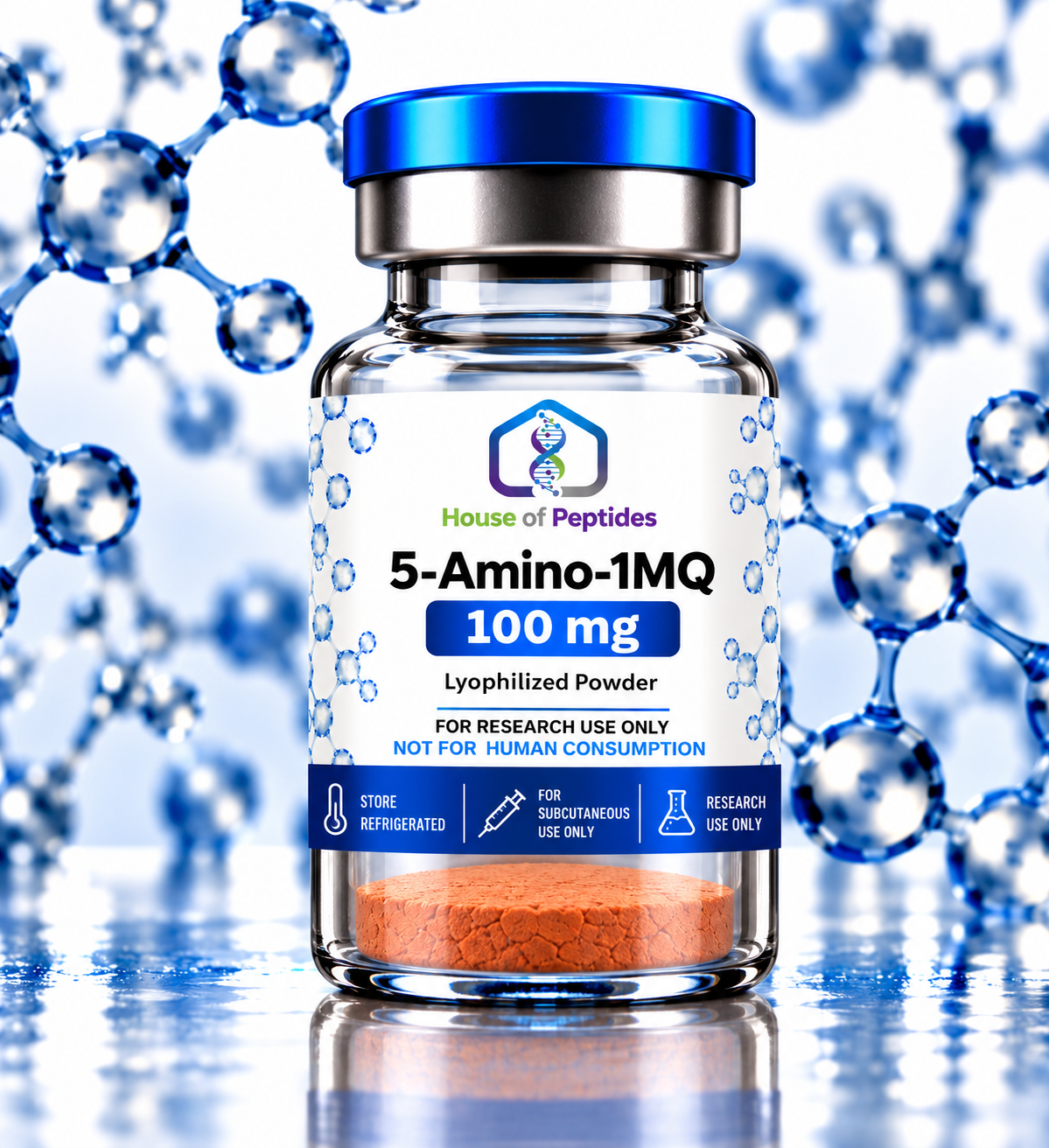
- Product: 5-Amino-1MQ 100mg
- Compound / formulation: 5-amino-1-methylquinolinium
- Labeled quantity / volume: 100mg per vial
- Physical form: Lyophilized powder
- Research focus: NNMT and cellular metabolism
- Available batch identifiers: Black cap
- SKU: HOP-5-AMINO-1MQ-100MG
- Intended classification: Laboratory research only
Independent Laboratory Testing
Chromate Laboratory, report #41116
- Compound reported: 5-Amino-1MQ
- Measured content: 101.7mg
- Purity: 99.638%
- Test date: October 23, 2026
- View laboratory report
House of Peptides maintains an established testing and sampling protocol with its suppliers. Under this agreed protocol, samples are randomly selected from a production batch and submitted for independent laboratory analysis.
The submitted samples are drawn from the same production batch as the corresponding inventory supplied to House of Peptides. This batch-based sampling approach provides analytical information associated with the production batch rather than individual testing of every vial.
House of Peptides may maintain inventory from multiple production batches of the same compound. Each Certificate of Analysis corresponds to its identified batch, which may be distinguished by cap color or lot designation. Orders are fulfilled on a first-in, first-out (FIFO) basis, so the batch supplied depends on available inventory at the time of fulfillment. Laboratory findings apply to the submitted samples from their respective batches, not to every individual vial.
Scientific Research Background
Cells use enzymes to help control chemical reactions. One of these enzymes, called NNMT, acts on nicotinamide, a form of vitamin B3 involved in cellular metabolism.
5-Amino-1MQ, also called 5-amino-1-methylquinolinium, is a synthetic small molecule studied for its ability to inhibit NNMT.
Researchers have investigated how this interaction affects fat cells and metabolic measurements in mice. Other animal studies have examined muscle repair and responses to exercise during aging.
These experiments help scientists investigate biological pathways. Their findings do not establish human weight-loss, muscle-building, or healthy-aging benefits from this research product.
Compound details
- Compound class: Small-molecule NNMT inhibitor
Clinical Research Observations
1. Why are scientists interested in 5-Amino-1MQ?
Cells rely on many chemical reactions to process nutrients and function. Enzymes help control these reactions.
One of these enzymes is called NNMT. Researchers study 5-Amino-1MQ because it can reduce this enzyme’s activity.
What researchers found: Laboratory studies identified 5-Amino-1MQ as an NNMT inhibitor and investigated how it affects processes inside fat cells.
Why it matters: Studying this interaction helps scientists understand how NNMT influences the way cells process nutrients.
2. What have researchers observed about body fat?
Body weight, the amount of fat tissue, and the size of fat cells give researchers different ways to study changes in body fat.
Scientists have examined these measurements in mice that developed obesity while eating a high-fat diet.
What researchers found: A 2018 study reported lower body weight, less fat tissue, and smaller fat cells in treated mice. Food intake did not differ from the comparison group.
Why it matters: These findings prompted interest in how NNMT affects body fat. Because the experiment involved mice, it does not establish a weight-loss benefit in people.
3. How does NAD+ fit into the research?
NAD+ helps cells carry out reactions involved in using energy.
Researchers can measure NAD+ to explore how a compound affects activity inside cells.
What researchers found: Experiments in laboratory-grown fat cells reported changes in NAD+ and other measurements after NNMT inhibition.
Why it matters: These observations help scientists investigate the connection between NNMT and cellular energy processes. A change inside a cell does not automatically mean a person will feel more energetic.
4. Why is 5-Amino-1MQ being studied in muscle repair?
Muscles contain stem cells that help repair damaged tissue.
Researchers have investigated whether changing NNMT activity affects how these cells respond to muscle injury in older mice.
What researchers found: A 2019 study reported more activity in muscle stem cells, larger repaired muscle fibers, and improvements in the muscles’ ability to produce force after treatment.
Why it matters: The findings help researchers explore muscle repair during aging. Further research is needed to determine whether similar effects occur in people.
5. What happened when researchers studied it alongside exercise?
Exercise and a research compound may affect muscle function in different ways.
To investigate this, researchers compared older mice receiving 5-Amino-1MQ, exercise using a weighted running wheel, both, or neither.
What researchers found: A 2024 study reported improvements in grip strength and some other muscle measurements. For certain measurements, the combined group showed greater improvements.
Why it matters: Comparing the groups helps researchers explore how NNMT inhibition and exercise affect muscle function. These animal findings do not establish improved exercise results in people.
6. Did all measures of muscle function improve?
Muscle function can be tested in several ways. A better result in one test may not appear in another.
What researchers found: In the same 2024 study, a separate test of the maximum turning force produced by a lower-leg muscle group did not show a significant improvement.
Why it matters: The mixed findings show why researchers use several tests. An improvement in grip strength alone does not establish that every aspect of muscle function has improved.
7. What is the overall scientific takeaway?
5-Amino-1MQ has attracted interest because of its effects on NNMT and the processes this enzyme influences inside cells.
The studies described here explored fat cells, body fat, muscle repair, and exercise responses in laboratory cells and mice.
What researchers found: Researchers reported changes in several measurements, while some muscle tests showed no significant improvement.
Why it matters: These studies help identify questions for further research. They do not yet establish whether the findings translate into meaningful benefits or an acceptable safety profile in people.
Findings from these experiments cannot automatically be applied to House of Peptides’ 5-Amino-1MQ 100mg research product.
Published Scientific Research
Neelakantan et al. (2018) — NNMT inhibition in fat cells and obese mice. Biochemical Pharmacology, 147:141–152. Examined small-molecule inhibitors, cellular metabolism, and mouse adiposity. Published online in 2017; journal issue dated 2018. PubMed — PMID 29155147. DOI:
10.1016/j.bcp.2017.11.007. Supports: Background; Questions 1–3 and 7.Neelakantan et al. (2019) — NNMT inhibition and repair of aged skeletal muscle. Biochemical Pharmacology, 163:481–492. Investigated muscle stem-cell activity and recovery after experimental injury in aged mice. PubMed — PMID 30753815. DOI:
10.1016/j.bcp.2019.02.008. Supports: Questions 4 and 7.Dimet-Wiley et al. (2024) — NNMT inhibition and exercise in aged mice. Scientific Reports, 14:15554. Compared inhibitor treatment, exercise, and their combination across several muscle outcomes. PubMed — PMID 38969654. DOI:
10.1038/s41598-024-66034-9. Supports: Questions 5–7.
Evidence boundary: These studies examined laboratory cells and animals. Their findings do not establish equivalent outcomes or safety in humans or for a separately sourced commercial research vial.
Understanding the Research Findings
5-Amino-1MQ is studied as a tool for investigating NNMT and cellular metabolism. The research findings depend on the experimental model and the measurements examined.
Analytical findings describe the submitted laboratory sample. They do not establish clinical effectiveness or human safety for House of Peptides’ 5-Amino-1MQ 100mg.
Research Use Notice
For laboratory research only. Not intended for human or veterinary administration, diagnostic, or therapeutic use.


Reviews
There are no reviews yet.