
Description
Product Specifications
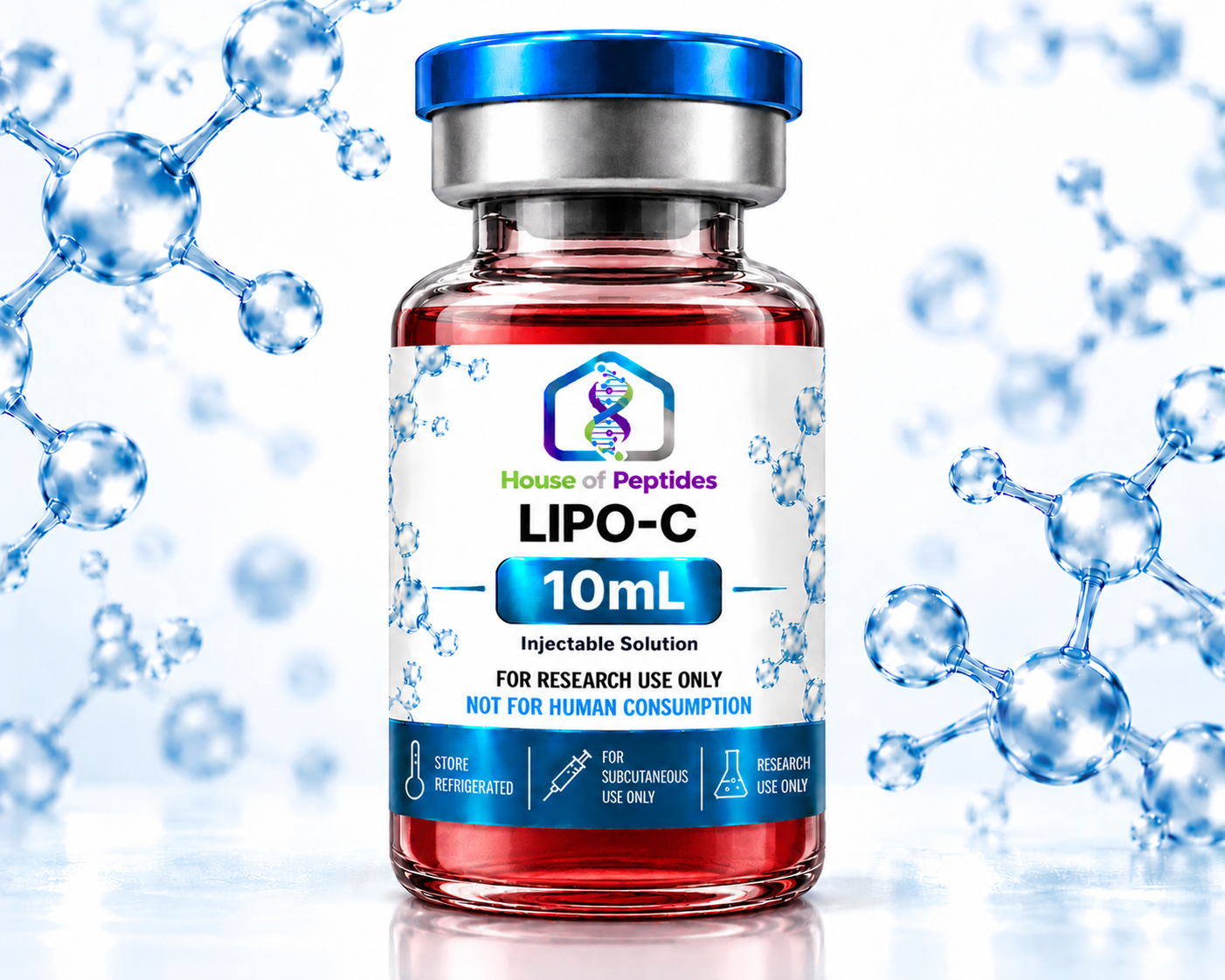
- Product: Lipo-C 10mL
- Compound / formulation: Eight-ingredient Lipo-C blend
- Labeled quantity / volume: 10mL
- Physical form: Transparent medium-red liquid
- Research focus: Metabolic Research, Lipid Metabolism, Nutrient Metabolism, Cellular Energy Research
- Available batch identifiers: Not documented in current product records
- SKU: HOP-lipoc-10-ml
- Intended classification: Laboratory research only
Quality & Laboratory Testing
House of Peptides may maintain inventory from multiple production batches of the same compound. Each Certificate of Analysis corresponds to its identified batch, which may be distinguished by cap color or lot designation. Orders are fulfilled on a first-in, first-out (FIFO) basis, so the batch supplied depends on available inventory at the time of fulfillment. Laboratory findings apply to the submitted samples from their respective batches, not to every individual vial.
Lipo-C 10mL contains eight ingredients at the concentrations listed in the formulation table.
The ingredient information is based on the supplied formulation specifications. A product-specific certificate of analysis has not been provided for independent review.
Accordingly, the listed concentrations have not been independently confirmed through the documentation currently available. No claims of verified purity, sterility, or endotoxin levels are made for this finished formulation.
Product Overview
Lipo-C 10mL — Eight-ingredient metabolic research formulation
Lipo-C 10mL is an eight-ingredient research formulation containing amino acids, vitamin-related compounds, and nutrients studied for their roles in normal cellular metabolism. Review the ingredient breakdown, published ingredient-level research, and product documentation.
For laboratory research only.
Formulation & Ingredient Breakdown
Each ingredient has a defined concentration in the supplied formulation specifications.
| Ingredient | Per 1mL | Per 10mL vial |
|---|---|---|
| L-Methionine | 25mg | 250mg |
| Inositol | 50mg | 500mg |
| Choline Chloride | 50mg | 500mg |
| L-Carnitine | 50mg | 500mg |
| Dexpanthenol (provitamin B5) | 25mg | 250mg |
| Vitamin B6 (Pyridoxine) | 25mg | 250mg |
| L-Arginine | 20mg | 200mg |
| Vitamin B12 (Methylcobalamin) | 1mg | 10mg |
Understanding the Ingredients
Energy metabolism
L-Carnitine helps transport certain fats within cells so they can be used for energy. Vitamins B5 and B12 participate in processes that help cells function normally.
Cellular and nutrient metabolism
Methionine, choline, and inositol participate in different cellular processes, including the handling of fats and the maintenance of cell structures.
Amino acid and vitamin research
L-Arginine is involved in nitric oxide production, while vitamin B6 supports numerous enzyme-driven reactions involved in metabolism.
Compound details
- Vitamin B12 form: Methylcobalamin
Clinical Research Observations
1. Why are the individual ingredients in Lipo-C studied?
The formulation contains nutrients and amino acids that participate in normal cellular processes.
What researchers found: Ingredient-level research describes roles for carnitine in fatty-acid transport, choline in cell membranes, vitamin B6 in enzyme reactions, and vitamin B12 in cellular function.
Why it matters: Understanding the biological roles of individual ingredients does not establish that combining them produces additional effects.
2. Has this eight-ingredient formulation been shown to cause weight loss or increase energy?
Evidence about individual nutrients is not the same as evidence about a finished mixture.
What researchers found: The ingredient references listed on this page do not test this particular eight-ingredient Lipo-C formulation.
Why it matters: The cited research does not establish weight-loss, energy, or therapeutic benefits from this specific formulation.
3. What is the overall scientific takeaway?
Ingredient-level studies provide background on normal metabolism.
What researchers found: The available references describe individual ingredients rather than clinical outcomes for this finished product.
Why it matters: Research on individual nutrients cannot verify the composition, safety, or clinical effects of this particular vial.
Research Background & Observations
Individual ingredients in Lipo-C have been studied for their roles in normal metabolic processes. These studies help researchers understand how nutrients and amino acids participate in cellular activity.
Research involving individual ingredients does not establish that this particular eight-ingredient formulation produces weight loss, increases energy, or provides a therapeutic benefit.
Published ingredient-level research references
NIH Office of Dietary Supplements — Carnitine (Health Professional Fact Sheet). Explains L-carnitine’s role in transporting long-chain fatty acids into mitochondria for energy production. https://ods.od.nih.gov/factsheets/Carnitine-HealthProfessional/
NIH Office of Dietary Supplements — Choline (Health Professional Fact Sheet). Describes choline’s role in cell-membrane components and normal metabolism. https://ods.od.nih.gov/factsheets/Choline-HealthProfessional/
NIH Office of Dietary Supplements — Vitamin B6 (Health Professional Fact Sheet). Describes the vitamin’s involvement in numerous enzyme reactions, especially protein metabolism. https://ods.od.nih.gov/factsheets/VitaminB6-HealthProfessional/
NIH Office of Dietary Supplements — Vitamin B12 (Health Professional Fact Sheet). Identifies methylcobalamin as an active form of vitamin B12 and describes its normal cellular functions. https://ods.od.nih.gov/factsheets/VitaminB12-HealthProfessional/
NIH Office of Dietary Supplements — Pantothenic Acid (Health Professional Fact Sheet). Background on vitamin B5 and coenzyme A. https://ods.od.nih.gov/factsheets/PantothenicAcid-HealthProfessional/
National Cancer Institute — Dexpanthenol. Identifies dexpanthenol as provitamin B5; does not test this formulation. https://www.cancer.gov/publications/dictionaries/cancer-drug/def/dexpanthenol
Palmer, Ashton, and Moncada (1988) — Vascular endothelial cells synthesize nitric oxide from L-arginine. Nature. Ingredient-level cellular mechanism, not a trial of the Lipo-C mixture. https://pubmed.ncbi.nlm.nih.gov/3131684/
Yavin (1985) — Polar head group decarboxylation and methylation of phospholipids: an alternate route for phosphatidylcholine formation in cultured neuronal cells. Journal of Neurochemistry. Cellular background on methionine-dependent phospholipid metabolism. https://pubmed.ncbi.nlm.nih.gov/3989543/
Holub (1975) — Role of cytidine triphosphate and cytidine diphosphate in promoting inositol entry into microsomal phosphatidylinositol. Lipids. Ingredient-level lipid biochemistry in rat microsomes. https://pubmed.ncbi.nlm.nih.gov/169452/
These references explain the biological roles of individual nutrients. They do not test this finished eight-ingredient formulation, verify its concentrations, or establish that it causes weight loss, increases energy, or provides therapeutic benefits.
Research Use Notice
For laboratory research only. Not intended for human or veterinary administration, diagnostic, or therapeutic use.


Reviews
There are no reviews yet.