Description
Product Specifications
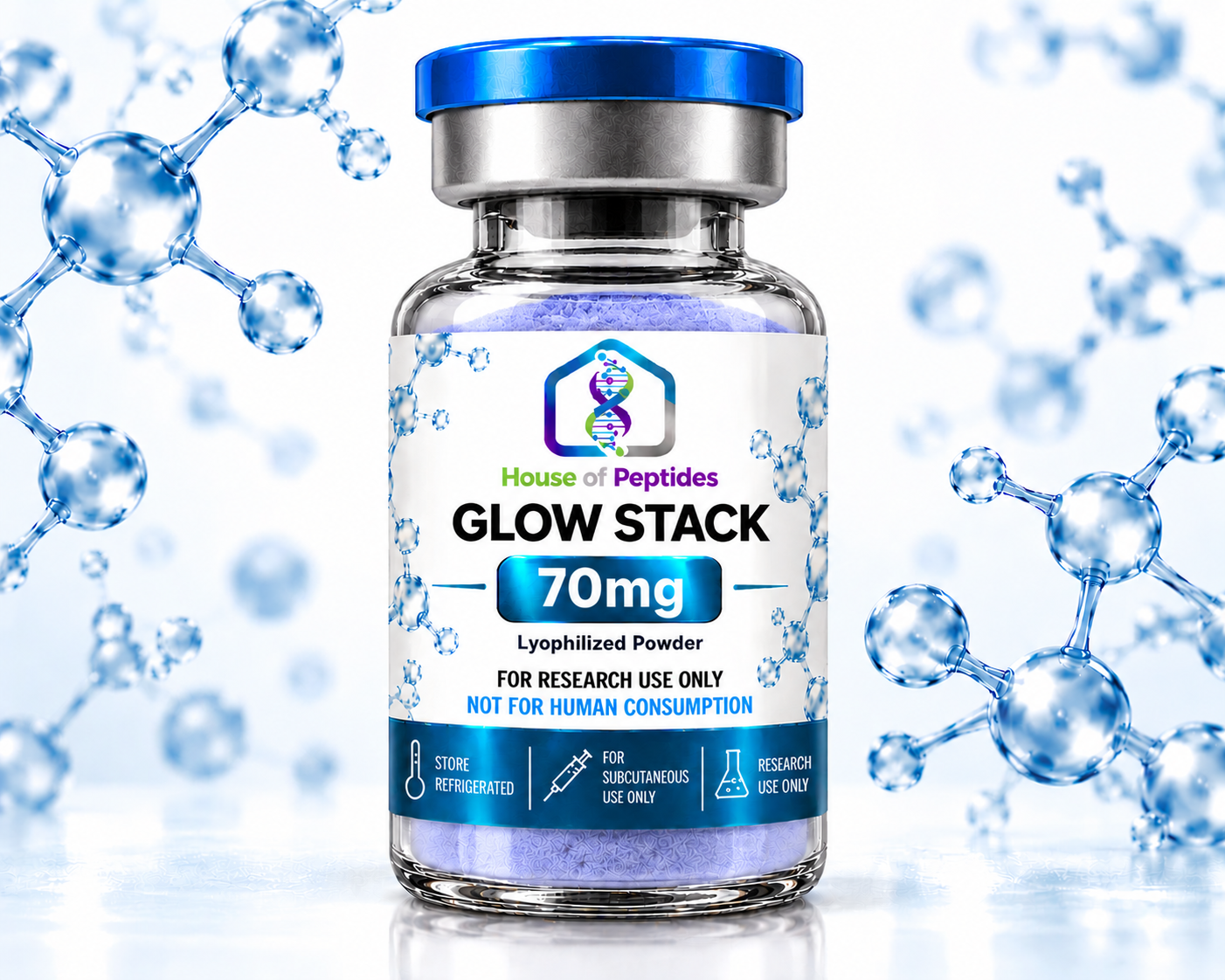
- Product: GLOW Stack 70mg
- Compound / formulation: GLOW Stack
- Labeled blend composition: GHK-Cu 50mg + TB-500 (TB4) 10mg + BPC-157 10mg
- Labeled quantity / volume: 70mg total per vial
- Physical form: White lyophilized powder
- Research focus: Skin & Cellular Research, Extracellular Matrix Research, Tissue Repair Research, Inflammatory Signaling
- Available batch identifiers: Magenta-purple cap, batch WBR-GLOW-517
- SKU: HOP-glow-stack-70mg
- Intended classification: Laboratory research only
Independent Laboratory Testing
Janoshik Analytical, report #223497 — Batch WBR-GLOW-517
- GHK-Cu measured content: 53.57mg
- TB-500 (TB4) measured content: 11.06mg
- BPC-157 measured content: 11.09mg
- Combined measured content: 75.72mg
- Test date: August 25, 2026
- View laboratory report
House of Peptides maintains an established testing and sampling protocol with its suppliers. Under this agreed protocol, samples are randomly selected from a production batch and submitted for independent laboratory analysis.
The submitted samples are drawn from the same production batch as the corresponding inventory supplied to House of Peptides. This batch-based sampling approach provides analytical information associated with the production batch rather than individual testing of every vial.
House of Peptides may maintain inventory from multiple production batches of the same compound. Each Certificate of Analysis corresponds to its identified batch, which may be distinguished by cap color or lot designation. Orders are fulfilled on a first-in, first-out (FIFO) basis, so the batch supplied depends on available inventory at the time of fulfillment. Laboratory findings apply to the submitted samples from their respective batches, not to every individual vial.
Scientific Research Background
GLOW Stack combines three compounds studied in different areas of tissue biology.
GHK-Cu is a copper-binding tripeptide complex associated with the naturally occurring GHK peptide. Researchers have investigated its influence on collagen production, extracellular matrix organization, fibroblast activity, and cellular responses involved in skin and connective tissue maintenance.
TB-500 (TB4) is the designation used for the second component in the product's laboratory report. Published research involving Thymosin Beta-4 has examined its relationship with cell movement, inflammation, and tissue organization. The analytical report does not specify a complete amino-acid sequence, so findings involving full-length Thymosin Beta-4 cannot automatically be attributed to every material marketed as TB-500.
BPC-157 is a synthetic peptide consisting of 15 amino acids. Experimental studies have investigated its relationship with tendon organization, blood vessel formation, and cellular responses following experimentally induced tissue injury.
Combining these compounds provides a formulation for laboratory investigation of several biological processes associated with connective tissue maintenance. Their individual research histories do not establish how the exact three-component blend behaves.
Compound details
- Composition details: GHK-Cu is a copper-peptide complex; BPC-157 is a 15-amino-acid peptide; TB-500 sequence not specified in the report
- Research classification: Multi-peptide connective tissue and cellular signaling research blend
Clinical Research Observations
Researchers have studied the individual peptides in GLOW Stack to better understand how skin and connective tissues maintain their structure and respond to injury. Most of these studies have involved laboratory experiments or animals rather than human clinical trials.
1. Why is GHK-Cu studied for collagen and skin structure?
Collagen helps give skin and connective tissue their structure. Researchers study the cells that produce it.
What researchers found: In laboratory studies, researchers examined how GHK and its copper complex interact with cells responsible for producing collagen.
They observed changes in collagen production and the materials that help give skin and connective tissues their structure and flexibility.
Why it matters: These findings have contributed to scientific interest in how GHK-Cu interacts with the processes involved in maintaining skin and connective tissues. Collagen changes in cells do not prove cosmetic results in people.
2. What have thymosin beta-4 studies shown about tissue repair?
Researchers have studied how the protective surface of the eye responds after experimental injury.
What researchers found: In a study involving mice with experimentally injured corneas—the clear outer surface of the eye—researchers observed that tissues treated with Thymosin Beta-4 restored their protective surface more quickly than untreated tissues.
The researchers also reported fewer inflammatory cells in the affected area.
These observations have contributed to scientific interest in how Thymosin Beta-4 interacts with cells involved in tissue repair and maintenance.
Why it matters: Animal and laboratory repair findings require human confirmation.
3. What have BPC-157 experiments found about connective tissue?
Researchers examine tendon strength, tissue structure, and movement when studying connective tissue injuries.
What researchers found: In a study involving rats with injured Achilles tendons, researchers observed differences in tendon strength, tissue organization, and movement compared with untreated animals.
The researchers also examined tendon-producing cells in laboratory experiments. They found that BPC-157 influenced how these cells responded to a substance that interferes with normal cell growth.
Why it matters: These findings contributed to scientific interest in how BPC-157 interacts with the tissues that connect muscles and bones. Connective-tissue findings in cells and animals do not establish human healing outcomes.
4. What can be concluded about the complete GLOW Stack?
Putting ingredients in one vial does not establish how they behave together.
What researchers found: Researchers have studied GHK-Cu, TB-500, and BPC-157 separately to understand their possible roles in tissue repair and inflammation. These findings help explain why scientists are interested in the individual ingredients. However, studies of the separate ingredients do not tell us how they work together in GLOW or establish that the complete blend is safe or effective in humans.
The Thymosin Beta-4 findings also cannot automatically be attributed to the TB-500 material in this blend without confirming that the tested compounds have the same molecular structure.
Why it matters: Individual ingredient findings cannot demonstrate effects of the combined formulation.
Published Scientific Research
- Pickart, Vasquez-Soltero, and Margolina (2015) — GHK Peptide as a Natural Modulator of Multiple Cellular Pathways in Skin Regeneration. BioMed Research International. https://doi.org/10.1155/2015/648108 — A scientific review examining GHK and GHK-Cu research involving collagen regulation, fibroblast activity, extracellular matrix organization, and skin-related cellular processes.
- Sosne et al. (2002) — Thymosin Beta 4 Promotes Corneal Wound Healing and Decreases Inflammation In Vivo Following Alkali Injury. Experimental Eye Research. https://doi.org/10.1006/exer.2001.1125 — An animal study investigating tissue restoration and inflammatory responses following experimental corneal injury. The study involved Thymosin Beta-4, not the GLOW blend.
- Staresinic et al. (2003) — Gastric Pentadecapeptide BPC 157 Accelerates Healing of Transected Rat Achilles Tendon and In Vitro Stimulates Tendocytes Growth. Journal of Orthopaedic Research. https://doi.org/10.1016/S0736-0266(03)00110-4 — An experimental investigation of tendon structure, mechanical properties, and cellular activity in animal and laboratory models.
Understanding the Research Findings
The research discussed above involves individual compounds investigated under different experimental conditions. These findings contribute to scientific understanding of collagen organization, cell movement, and connective tissue biology, but they do not establish how the exact GLOW Stack formulation behaves.
The distinction between TB-500 and full-length Thymosin Beta-4 is especially important. The laboratory report uses the designation TB-500 (TB4) without specifying a complete peptide sequence. Published findings involving Thymosin Beta-4 should therefore be understood as related scientific background, not direct validation of that component's biological activity.
Independent laboratory testing provides information about the measured quantities of the submitted blend sample. It does not establish clinical effectiveness, safety, or equivalence to materials evaluated in published studies.
House of Peptides' research product is not FDA-approved or represented as clinically equivalent to pharmaceutical or experimental materials used in clinical investigations.
Research Use Notice
For laboratory research only. Not intended for human or veterinary administration, diagnostic, or therapeutic use.

Reviews
There are no reviews yet.