By [Your Name]
Educational Feature — For Informational Purposes Only
It’s been called the “Wolverine Stack” — a nickname for the combination of two experimental peptides, BPC‑157 and TB‑500, being studied for their potential roles in tissue recovery, injury repair, and inflammation control.
While it sounds exciting, it’s crucial to note that both are research compounds, not approved medications. Scientists are still uncovering what they do — and what they might mean for the future of regenerative medicine.
What Are Peptides?
Peptides are short strands of amino acids — the building blocks of proteins — that act like molecular signals. They can tell cells how to behave: when to grow, divide, or repair themselves.
In research, synthetic peptides allow scientists to explore these effects in controlled lab and animal studies. Some — like BPC‑157 and TB‑500 — are being studied for their influence on muscle, tendon, and connective tissue repair.
⚠️ Important Disclaimer: These peptides are not FDA approved‑ for human use. They are only studied under laboratory or preclinical conditions.
Breaking Down the Wolverine Stack
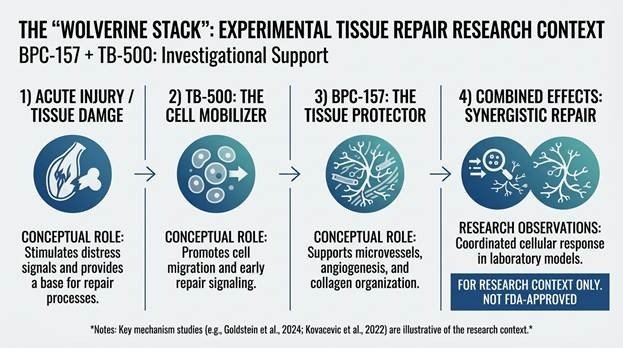
BPC‑157: The Tissue Protector
BPC‑157 (Body Protection Compound‑157) is a synthetic fragment derived from a naturally occurring stomach protein. Preclinical studies suggest it may promote angiogenesis (blood vessel growth) and help maintain collagen organization — both key parts of the healing process.
- In animal models, BPC‑157 accelerated tendon and muscle repair and improved blood flow to injured tissue (Frontiers in Pharmacology, 2022).
- In rodent studies, it showed potential anti-inflammatory‑ and gastroprotective effects (Current Neuropharmacology, 2021).
Researchers propose that it works by enhancing the body’s natural repair pathways — though no clinical human trials have confirmed this.
TB‑500: The Mobilizer
TB‑500 is a synthetic version of a portion of Thymosin β4, a peptide involved in cell movement and structural repair.
Studies suggest TB‑500 may encourage cell migration — the process by which cells move to where they’re needed for healing — and help organize actin, a protein vital to cellular structure.
- Thymosin β4 and TB‑500 have been shown in animal models to accelerate wound healing and tissue regeneration (Annals of the New York Academy of Sciences, 2020).
- Some research links them to improved muscle fiber repair and reduced inflammation in damaged tissue (Journal of Translational Medicine, 2024 link.springer.com).
Why Combine Them?
Researchers theorize that the synergy between these two peptides could be stronger than either one alone.
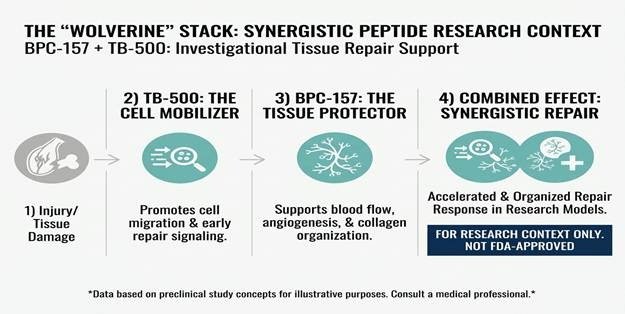
So far, animal studies combining the two suggest enhanced collagen formation, faster regeneration, and reduced inflammation, but these are early findings. As with all experimental compounds, results in animals don’t necessarily translate to humans.
Infographic: How the “Wolverine Stack” Works
The Current Research Landscape
Even though no peer reviewed‑ human trials exist yet for the “stack,” several lines of research are informing it indirectly:
- Tissue Regeneration Models: Preclinical data suggest improved tendon and muscle healing in rats.
- Angiogenesis Mechanisms: Studies like those in Frontiers in Pharmacology (2022) show modulation of nitric oxide and ‑growth factor‑ pathways.
- Systemic Effects: Ongoing metabolic and inflammatory signaling studies continue to map how these peptides might affect recovery at the cellular level, similar to‑ how fasting molecules like Mimio are being examined for cardiometabolic benefits in humans nature.com.
Safety and Legality
Because BPC‑157 and TB‑500 are not approved for human or veterinary use, they have no established dosing, purity standards, or safety data. Any product sold online as a supplements is unregulated and may not contain what is claimed. Using unverified peptides poses health and legal risks.
Regulatory agencies worldwide classify these as research‑only materials, suitable for controlled laboratory investigation — not personal or clinical use.
The Future of Regenerative Research
The excitement around the Wolverine Stack reflects a broader trend: combining targeted molecules that influence different stages of the repair cycle. If science continues to confirm these synergies, such approaches could contribute to next‑generation regenerative therapies — carefully tested, precisely dosed, and backed by rigorous data.
But getting there takes time. Every promising signal in the lab must survive years of safety testing, reproducibility studies, and ethical oversight.
Until then, the blend remains what it is now — a fascinating research tool, not a medical treatment
Study Reference Table
| Study | Year | Focus | Key Findings | Source |
| Kovacevic et al. | 2022 | Frontiers in Pharmacology | BPC‑157 promoted angiogenesis and tendon healing in animal models | frontiersin.org |
| Goldstein et al. | 2024 | Journal of Translational Medicine | Thymosin β4 (TB‑500) enhanced wound repair through actin modulation | link.springer.com |
| Milenko et al. | 2021 | Current Neuropharmacology | BPC157 showed anti-inflammatory and neuroprotective effects in preclinical settings | pubmed.ncbi.nlm.nih.gov |
| Nature Communications Trial | 2025 | Nature Communications | Highlighted links between GLP‑1 biology and metabolic recovery, informing future regenerative targets | nature.com |
| Scientific Reports Trial | 2026 | Scientific Reports | Fasting mimetic agent “Mimio” improved metabolic repair markers, demonstrating systemic recovery potential | nature.com |
Bottom Line
The “Wolverine Stack” — combining BPC157 and TB500 — reflects a growing scientific interest in multi pathway recovery. While the concept is fascinating, it’s still entirely experimental.
If future, well controlled human studies confirm safety and benefit, it might open doors for regenerative therapies.
Legal Disclaimer
This article is intended for educational and informational purposes only.
BPC157 and TB500 are research peptides not approved for clinical use by the U.S. Food and Drug Administration (FDA) or similar global agencies.
The information above does not constitute medical advice, diagnosis, or treatment. Always consult a licensed healthcare professional before making health related decisions.