

Description
Product Specifications
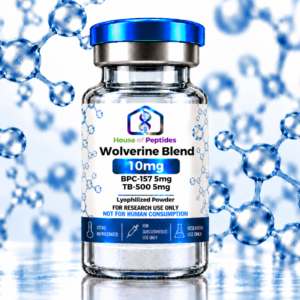
- Product: Wolverine Blend 20mg
- Compound / formulation: Wolverine Blend 20mg
- Labeled blend composition: BPC-157 10mg + TB-500 10mg
- Labeled quantity / volume: 20mg per vial
- Physical form: White lyophilized powder — standard catalog designation
- Research focus: Tissue biology, cellular signaling, experimental injury models
- Available batch identifiers: Pink/magenta cap; batch SB-P01
- SKU: HOP-WOLVERINE-20MG
- Intended classification: Laboratory research only
The listed quantities describe the product label.
Independent Laboratory Testing
Pink/magenta cap — Chromate Laboratory, report #40831 — Batch SB-P01
- Compounds reported: BPC-157 and TB-500 (TB4)
- BPC-157 measured content, sample 1: 10.30mg
- BPC-157 measured content, sample 2: 10.57mg
- TB-500 (TB4) measured content, sample 1: 10.39mg
- TB-500 (TB4) measured content, sample 2: 10.73mg
- Purity, sample 1: 98.913%
- Purity, sample 2: 99.023%
- Test date: October 16, 2026
- View laboratory report
House of Peptides maintains an established testing and sampling protocol with its suppliers. Under this agreed protocol, samples are randomly selected from a production batch and submitted for independent laboratory analysis.
The submitted samples are drawn from the same production batch as the corresponding inventory supplied to House of Peptides. This batch-based sampling approach provides analytical information associated with the production batch rather than individual testing of every vial.
House of Peptides may maintain inventory from multiple production batches of the same compound. Each Certificate of Analysis corresponds to its identified batch, which may be distinguished by cap color or lot designation. Orders are fulfilled on a first-in, first-out (FIFO) basis, so the batch supplied depends on available inventory at the time of fulfillment. Laboratory findings apply to the submitted samples from their respective batches, not to every individual vial.
Additional Product Details
- Ingredient ratio: 1:1 by labeled mass
Scientific Research Background
When tissue is injured, the body begins a complex repair process. Cells communicate with one another, move into affected areas, and help restore the structure of damaged tissue.
Scientists investigate peptides to better understand these processes.
BPC-157 is a synthetic peptide made up of 15 amino acids. Researchers have investigated it in experimental models involving tendons, muscles, ligaments, and other tissues.
Some animal studies have reported favorable changes in measurements associated with tissue repair. However, human research remains limited, and these findings do not establish clinical effectiveness.
TB-500 is a commercial designation associated with thymosin beta-4-related research peptides.
Thymosin beta-4 is a naturally occurring peptide studied for its relationship with actin, a protein that helps cells maintain their shape and move.
An important scientific distinction is that TB-500 and full-length thymosin beta-4 are not necessarily identical compounds. Without sequence-specific analytical documentation, findings involving one cannot automatically be applied to the other.
Wolverine Blend combines these two labeled research materials. Published studies provide scientific background on the individual compounds, but do not establish that combining them produces stronger, complementary, or predictable biological effects.
Compound details
- Research classification: Peptide blend
Clinical Research Observations
1. Why are scientists interested in BPC-157 and TB-500?
When tissues are damaged, cells must coordinate several activities to repair and reorganize the affected area.
Scientists study peptides because some interact with biological processes involved in these responses.
What researchers found: Laboratory and animal investigations involving BPC-157 have reported changes in selected tissue-repair measurements. Separate studies involving thymosin beta-4 have examined cell movement, tissue organization, and inflammatory responses.
Why it matters: These observations help researchers understand how tissues respond to injury. They do not demonstrate that Wolverine Blend improves healing in humans.
2. What has BPC-157 research shown about tendons?
Tendons connect muscles to bones and transfer the forces that allow us to move.
Some tendons have a relatively limited blood supply, which can make recovery from injury challenging.
Researchers have investigated BPC-157 in experimental tendon-injury models.
What researchers found: Animal studies have reported improvements in selected measurements of tendon structure and function. A 2025 systematic review identified 36 relevant studies, 35 of which involved laboratory or animal research.
Why it matters: These findings help scientists investigate the biological processes involved in tendon repair. Results from animal models do not establish that BPC-157 improves tendon recovery in people.
3. What about muscle and ligament research?
Muscles produce movement, while ligaments connect bones and help stabilize joints.
Although these tissues perform different functions, both depend on coordinated cellular responses following injury.
What researchers found: Experimental studies involving BPC-157 have reported favorable changes in certain structural, mechanical, and functional measurements following muscle and ligament injuries in animals.
Why it matters: These observations provide useful scientific information about tissue-repair processes. They do not establish improved strength, mobility, or recovery in humans.
4. Why is thymosin beta-4 studied in tissue repair?
For damaged tissue to reorganize, cells sometimes need to move into affected areas.
Thymosin beta-4 has attracted scientific interest because of its relationship with proteins involved in cell movement.
What researchers found: In a study involving mice with experimentally injured corneas—the clear outer surfaces of their eyes—researchers observed faster restoration of the tissue surface and fewer inflammatory cells after treatment with full-length thymosin beta-4.
Why it matters: These findings help researchers understand tissue responses in an animal model. They do not establish equivalent effects for a TB-500 material whose exact molecular structure has not been confirmed.
5. Have these peptides been studied in humans?
Human studies help researchers determine whether findings from laboratory and animal experiments translate into meaningful outcomes for people.
What researchers found: A 2026 systematic review identified three small human studies involving BPC-157, with 30 participants altogether. The reviewers rated the overall certainty of evidence as very low because of weaknesses in study design and the small amount of available data.
Research involving full-length thymosin beta-4 also exists, but those findings cannot automatically be applied to a material labeled TB-500.
Why it matters: The available evidence does not establish the safety or effectiveness of Wolverine Blend in humans.
6. Does combining BPC-157 and TB-500 make them more effective together?
Scientists sometimes investigate combinations of compounds to determine whether their biological effects interact.
However, a beneficial interaction must be demonstrated through controlled experiments rather than assumed from separate studies.
What researchers found: The reviewed literature does not establish a demonstrated benefit from the two compounds working together, improved clinical outcome, or confirmed human safety profile for this BPC-157/TB-500 combination. A 2026 medical review also emphasizes the substantial limitations in available human evidence for these research peptides.
Why it matters: Two compounds showing activity in separate experiments does not prove that combining them produces better results.
7. What is the overall scientific takeaway?
BPC-157 and thymosin beta-4-related compounds remain subjects of scientific interest because of their relationships with cellular signaling and tissue biology.
What researchers found: Most directly relevant BPC-157 findings still come from laboratory and animal studies, and the limited human evidence is of very low certainty. Research involving full-length thymosin beta-4 does not automatically establish the identity or effects of a material labeled TB-500.
Why it matters: Wolverine Blend is an investigational research combination. Its clinical effects, safety, and effectiveness have not been established in humans.
Published Scientific Research
The following publications provide scientific context for the individual research compounds. They do not establish the identity, safety, effectiveness, or analytical characteristics of House of Peptides' Wolverine Blend.
Vasireddi et al. (2025) — Emerging Use of BPC-157 in Orthopaedic Sports Medicine: A Systematic Review. HSS Journal. Reviewed 36 studies, including 35 preclinical investigations. Animal models reported favorable findings in selected musculoskeletal measurements, while reliable human evidence remained limited. PubMed — PMID 40756949. DOI:
10.1177/15563316251355551. Supports: Clinical Questions 2, 3, and 7.Poolton, Minett & Kazmi (2026) — Human evidence for BPC-157 in orthopaedic and regenerative medicine: a systematic review of efficacy and safety. Acta Orthopaedica Belgica. Identified three small human studies involving 30 participants, with very low overall certainty of evidence. PubMed — PMID 42885452. DOI:
10.52628/92.3.15837. Supports: Clinical Questions 5 and 7.Sosne et al. (2002) — Thymosin beta 4 promotes corneal wound healing and decreases inflammation in vivo following alkali injury. Experimental Eye Research. Animal study reporting changes in corneal repair and inflammatory responses following treatment with full-length thymosin beta-4. PubMed — PMID 11950239. DOI:
10.1006/exer.2001.1125. Supports: Clinical Question 4. This study does not directly establish TB-500 effects.Mayfield et al. (2026) — Injectable Peptide Therapy: A Primer for Orthopaedic and Sports Medicine Physicians. The American Journal of Sports Medicine. Narrative review discussing BPC-157, TB-500, thymosin beta-4, and related peptides. Describes predominantly preclinical findings and limitations in available human research. PubMed — PMID 41476424. DOI:
10.1177/03635465251357593. Supports: Clinical Questions 1, 5, 6, and 7.
Evidence boundary: Laboratory and animal findings do not establish human benefit. Research involving full-length thymosin beta-4 cannot automatically be attributed to an independently uncharacterized TB-500 ingredient. Studies of individual compounds do not establish the effects of their combination.
Understanding the Research Findings
The scientific literature contains experimental findings involving BPC-157 and thymosin beta-4-related biological processes.
However, most relevant BPC-157 evidence comes from animal studies, human evidence remains limited, and the molecular identity of the TB-500 ingredient has not been independently established for this product.
Research findings involving the individual compounds cannot demonstrate how this specific combination behaves.
The available evidence does not establish human safety, clinical effectiveness, or equivalence to materials used in published research.
Research Use Notice
For laboratory research only. Not intended for human or veterinary administration, diagnostic, or therapeutic use.

Reviews
There are no reviews yet.