Description
Product Specifications
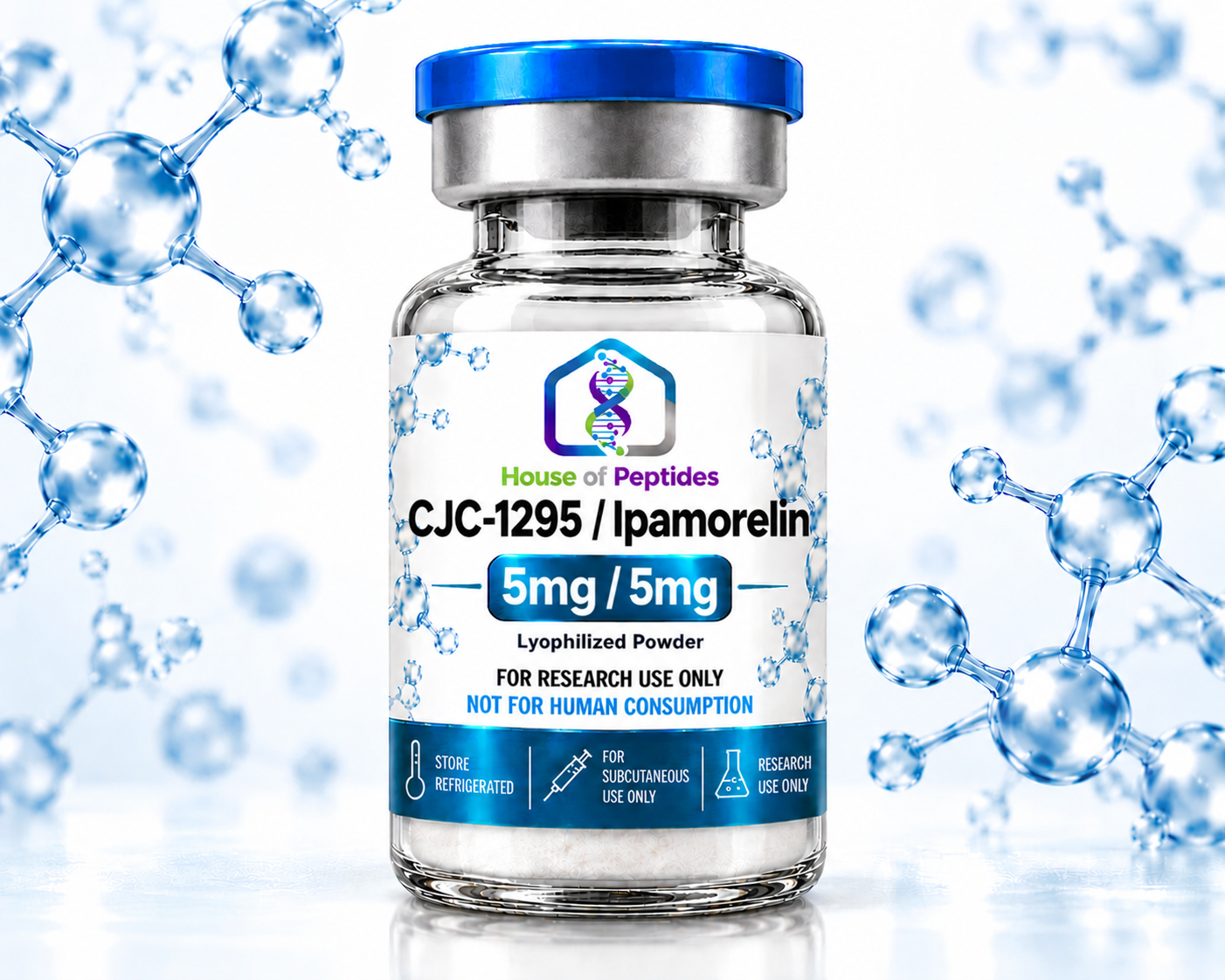
- Product: CJC-1295 / Ipamorelin 5mg/5mg
- Compound / formulation: CJC-1295 without DAC / Ipamorelin
- Labeled blend composition: 5mg Mod GRF 1–29 + 5mg Ipamorelin
- Labeled quantity / volume: 10mg total per vial
- Physical form: White lyophilized powder
- Research focus: Growth Hormone Research, Endocrine Signaling, GH Secretagogue Research, IGF-1 Regulation
- Available batch identifiers: Medium blue, batch MYP90108; white cap, lot CP10-HV-26
- SKU: HOP-cjc1295—ipamorelin-10mg
- Intended classification: Laboratory research only
Independent Laboratory Testing
Janoshik Analytical, report #224629 — Batch MYP90108
- CJC-1295 (Mod GRF 1–29) measured content: 5.13mg
- Ipamorelin measured content: 5.21mg
- Combined measured content: 10.34mg
- Test date: August 26, 2026
- View laboratory report
White cap — BT Labs — Lot CP10-HV-26
- Compound reported: CJC-1295 Ipamorelin
- CJC-1295 measured content: 6.1mg
- Ipamorelin measured content: 6.2mg
- Combined measured content: 12.3mg
- Purity: 99.9%
- Test date: October 23, 2026
- View laboratory report
- View bacterial endotoxins report COA262049-019
The BT Labs report does not expressly identify the CJC-1295 component as without DAC.
House of Peptides maintains an established testing and sampling protocol with its suppliers. Under this agreed protocol, samples are randomly selected from a production batch and submitted for independent laboratory analysis.
The submitted samples are drawn from the same production batch as the corresponding inventory supplied to House of Peptides. This batch-based sampling approach provides analytical information associated with the production batch rather than individual testing of every vial.
House of Peptides may maintain inventory from multiple production batches of the same compound. Each Certificate of Analysis corresponds to its identified batch, which may be distinguished by cap color or lot designation. Orders are fulfilled on a first-in, first-out (FIFO) basis, so the batch supplied depends on available inventory at the time of fulfillment. Laboratory findings apply to the submitted samples from their respective batches, not to every individual vial.
Scientific Research Background
The body uses more than one signal to control growth hormone release. Scientists study how these signals work separately and together.
This blend contains CJC-1295 without DAC, also called modified GRF 1–29, and ipamorelin. They interact with different receptor systems involved in growth hormone release.
Modified GRF 1–29 is a synthetic peptide made from 29 amino acids. It is based on growth hormone-releasing hormone, or GHRH. It does not contain the drug-affinity complex (DAC) used to extend activity in a different form of CJC-1295. Findings about that longer-acting form cannot automatically be applied to the version in this blend.
Ipamorelin is a five-amino-acid peptide investigated for its effects on growth hormone release and how its hormone response differs from other compounds.
The two signaling systems provide a reason to investigate a combination. However, studies of related hormones do not establish the response or human safety of this exact blend.
Compound details
- Peptide lengths: 29 and 5 amino acids, respectively
- Research classification: GHRH analog / growth hormone secretagogue blend
Clinical Research Observations
Researchers have studied how different peptides influence the body's natural release of growth hormone. Growth hormone plays a role in growth, metabolism, and the maintenance of muscles, bones, and other tissues.
1. What has research shown about ipamorelin and growth hormone?
Researchers have studied whether ipamorelin changes growth hormone release and how its response compares with other compounds.
What researchers found: In a 1998 study involving laboratory cells and animals, researchers found that ipamorelin stimulated growth hormone release.
They also observed that ipamorelin had a more selective hormonal response than certain other compounds being studied. In animal experiments, it stimulated growth hormone without producing the same increases in some other hormones, including cortisol, seen with certain comparison compounds.
Why it matters: These findings contributed to scientific interest in ipamorelin as a compound that interacts with the body's growth hormone signaling system. Cell and animal hormone responses cannot predict human outcomes.
2. Can two growth hormone signals interact?
Different hormone signals can interact. Researchers have investigated whether the combined response differs from their separate effects.
What researchers found: In a 2001 human study, researchers examined two naturally occurring hormone signals: ghrelin and growth hormone-releasing hormone (GHRH).
When researchers administered the two together at certain study doses, they observed a greater growth hormone response than would be expected by simply adding their individual responses.
Why it matters: This finding helped demonstrate that different signals involved in growth hormone release can reinforce one another. The human findings concern ghrelin and GHRH, not this specific combination.
3. Have these findings been demonstrated for the actual blend?
A study of two related hormone signals does not necessarily test the two ingredients in this vial.
What researchers found: CJC-1295 without DAC and ipamorelin interact with different systems involved in growth hormone release, making their combination an area of scientific interest.
However, the human study described above used ghrelin and GHRH—not CJC-1295 without DAC and ipamorelin. It does not establish that this specific blend produces the same response or leads to changes in muscle growth, body composition, or recovery in humans.
Why it matters: Results from separate compounds cannot establish the efficacy or safety of the finished blend.
Published Scientific Research
- Raun et al. (1998), Ipamorelin, the First Selective Growth Hormone Secretagogue, European Journal of Endocrinology. https://doi.org/10.1530/eje.0.1390552 — This study examined ipamorelin's growth hormone-releasing activity and hormonal selectivity in laboratory and animal models.
- Hataya et al. (2001), A Low Dose of Ghrelin Stimulates Growth Hormone (GH) Release Synergistically with GH-Releasing Hormone in Humans, Journal of Clinical Endocrinology & Metabolism. https://doi.org/10.1210/jcem.86.9.8002 — This study observed complementary growth hormone signaling in humans using ghrelin and GHRH, not the CJC-1295 / Ipamorelin blend.
- Teichman et al. (2006), Prolonged Stimulation of Growth Hormone (GH) and Insulin-Like Growth Factor I Secretion by CJC-1295, a Long-Acting Analog of GH-Releasing Hormone, in Healthy Adults, Journal of Clinical Endocrinology & Metabolism. https://doi.org/10.1210/jc.2005-1536 — This study investigated DAC-containing CJC-1295 and is included to distinguish it from the without-DAC component in this research blend.
Understanding the Research Findings
The published studies describe how growth hormone signaling responds to different research compounds under specific experimental conditions. Findings involving ipamorelin, ghrelin, GHRH, or DAC-containing CJC-1295 should not be interpreted as evidence that House of Peptides' CJC-1295 without DAC / Ipamorelin blend produces the same results.
The reported interaction between the two growth hormone regulatory pathways provides a basis for further research, but does not demonstrate synergy for this specific formulation.
Independent laboratory testing provides analytical information about the submitted blend sample, including measured quantities of both peptides. These findings do not establish pharmaceutical equivalence, clinical effectiveness, safety, or the analytical status of every individual vial.
House of Peptides' research product is not represented as clinically equivalent to materials evaluated in published investigations.
Research Use Notice
For laboratory research only. Not intended for human or veterinary administration, diagnostic, or therapeutic use.
Reviews
There are no reviews yet.