Ready to discover the next wave in wellness and recovery? Meet the Glow Peptide Protocol—a powerhouse blend of three peptides: BPC-157, TB-500, and GHK-Cu. This cutting-edge combination is making waves in labs and brings together the latest research on healing, regeneration, and skin health. Here’s your magazine-style guide to what makes this blend so exciting!
What Are Peptides?
Peptides are tiny protein fragments—think of them as the body’s natural “messengers,” telling cells how to heal, grow, and repair. Scientists are fascinated by how they can influence muscle, tendon, and skin rejuvenation .
Inside the Glow Blend:
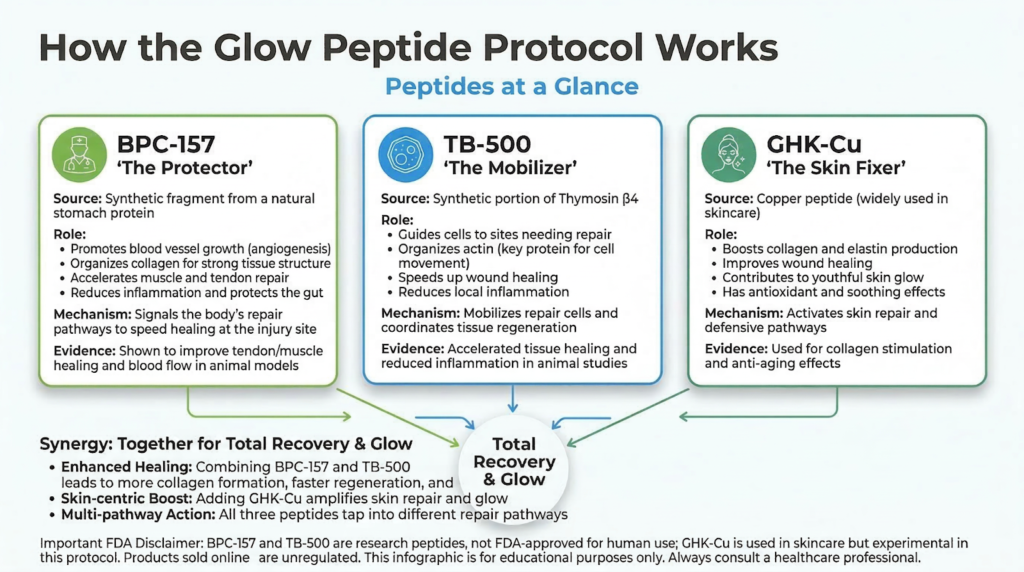
- BPC-157: The Protector
- Derived from a natural stomach protein, BPC-157 is recognized for its role in speeding up tissue repair, supporting blood vessel growth, and organizing collagen—the stuff that makes skin and tendons strong and supple .
- Animal studies show boosted healing and anti-inflammatory benefits, though it’s still in the research phase for humans .
- TB-500: The Mobilizer
- This lab-made peptide is inspired by Thymosin β4, which helps cells move where they’re needed for repair. It works by organizing actin (a key cell protein), speeding up wound healing, and reducing inflammation .
- In animal models, TB-500 has shown faster muscle recovery and tissue regeneration .
- GHK-Cu: The Skin Fixer
- GHK-Cu is a copper peptide loved in the skincare world for energizing collagen and elastin production, improving wound healing, and infusing the skin with that healthy glow .
- Its antioxidant and soothing properties round out the Glow Protocol’s benefits .
The “Wolverine Stack” – Proven Synergy
Why all the buzz around the “Wolverine Stack”? Researchers saw that combining BPC-157 and TB-500 could supercharge the healing process. Together, they enhance collagen formation, accelerate tissue regeneration, and slash inflammation more than either peptide alone . This laid the foundation for the Glow Protocol—and when GHK-Cu is added, you get extra skin-repair power!
What the Studies Show
- BPC-157: Improved tendon and muscle repair, increased blood flow, and reduced inflammation in animal models (Frontiers in Pharmacology, 2022) .
- TB-500: Enhanced wound healing and tissue repair, especially when combined with Thymosin β4, in preclinical studies (Journal of Translational Medicine, 2024) .
- Combination (Wolverine Stack): Greater collagen formation and speedier regeneration compared to single peptides .
- GHK-Cu: Widely used in skincare for collagen stimulation and anti-aging effects .
Important Safety and FDA Disclaimer
BPC-157 and TB-500 are strictly research compounds, not approved by the FDA for human use. They’re studied under laboratory conditions and have no established dosing, purity standards, or regulated safety profile. GHK-Cu is more common in skincare, but as part of this protocol it’s experimental. Any peptide products sold online are unregulated and could be risky .
This article is for educational and informational purposes only. None of these peptides are approved for clinical use by the FDA or similar global agencies. Always consult a licensed healthcare professional before making health-related decisions.
Bottom Line
While the Glow Peptide Protocol is truly exciting for researchers—and the synergy of BPC-157, TB-500, and GHK-Cu could shape the future of advanced recovery and radiant health—it’s still in the “science in progress” stage. If human trials confirm these benefits, this blend may one day revolutionize wellness and repair.
For now: Stay curious, stay cautious, and watch for the breakthroughs!
References:
- Frontiers in Pharmacology, 2022: BPC-157 promoted angiogenesis and tendon healing in animal models
- Journal of Translational Medicine, 2024: TB-500 improved muscle repair via actin modulation
- Current Neuropharmacology, 2021: BPC-157 showed anti-inflammatory effects
- Nature Communications, 2025: Metabolic recovery trials
- Annals of the New York Academy of Sciences, 2020: TB-500 accelerated wound healing