Small molecule. Decades of science. A lot of curiosity.
Important Notice
This article is for educational and informational purposes only.
All studies referenced involve laboratory and scientific models.
GHK‑Cu is for Research Use Only and is not an approved drug, supplement, or cosmetic product .
Why GHK‑Cu Attracts So Much Attention
Some peptides become popular because of trends. GHK‑Cu became popular because of decades of science. It has been studied since the 1970s and continues to appear in research related to tissue repair, cosmetic science, inflammation balance, aging biology, and cellular resilience .
Even people brand new to peptide research often feel like they’ve already heard of it. GHK‑Cu shows up in discussions about youthful‑looking skin, wound environments, age‑related tissue changes, and how the body maintains structure over time.
Researchers often describe GHK‑Cu as a “reminder signal”—a message that helps tissue remember how to repair, reorganize, and rebuild in research models .
Why GHK‑Cu Shows Up in So Many Conversations
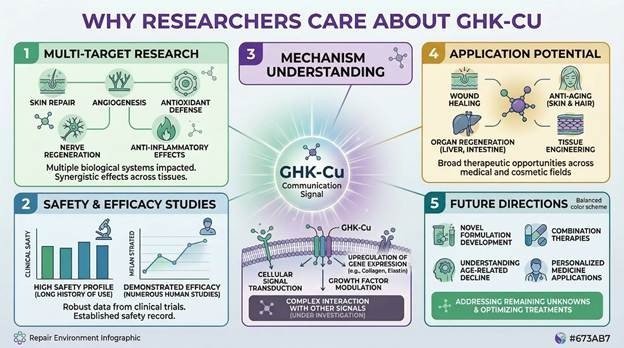
Researchers studying GHK‑Cu are often exploring questions like:
- Why youthful tissue repairs more efficiently
- What supports firm, healthy‑looking skin in research models
- Why tissue remodeling slows with age
- Whether natural signals guide regeneration
GHK‑Cu is naturally present in plasma, saliva, and tissue—and it declines with age. This pattern led scientists to investigate whether it simply exists in youthful tissue or actively helps maintain it .
GHK‑Cu in Skin and Hair Research
GHK‑Cu appears frequently in laboratory studies focused on:
- Skin firmness and elasticity
- Hair follicle activity and root strength
- Dermal papilla function (linked to thicker‑looking hair)
- Collagen and elastin organization
- Microcirculation around follicles
- Antioxidant protection in stressed tissue
Because hair health depends heavily on skin and connective tissue quality, peptides studied for collagen organization often appear in hair research as well.
How GHK‑Cu Works in Research Models
GHK‑Cu stands for Glycyl‑L‑Histidyl‑L‑Lysine bound to copper. When bound to copper, it functions as a signaling molecule.
Researchers don’t describe GHK‑Cu as a builder.
They describe it as a communicator.
In research models, GHK‑Cu has been observed to:
- Support collagen‑related pathways
- Influence fibroblast activity
- Help remodel damaged tissue
- Balance inflammatory responses
- Increase antioxidant activity
- Shift gene expression toward repair‑oriented profiles
GHK‑Cu, Inflammation, and Oxidative Stress
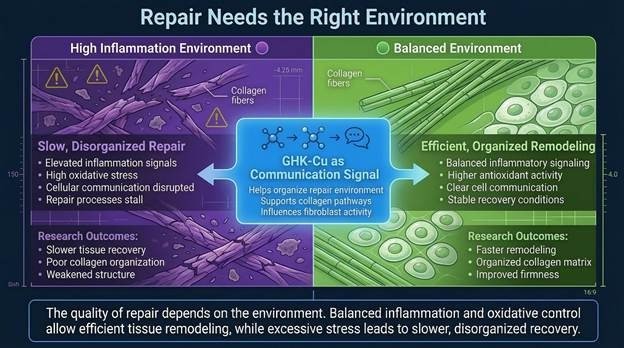
Successful tissue repair depends on balance. Too much inflammation or oxidative stress can disrupt recovery.
Research observations often associate GHK‑Cu with:
- Reduced pro‑inflammatory markers
- Increased antioxidant enzymes
- Improved protection of stressed cells
- More stable conditions for healing and organization
How GHK‑Cu Compares to Other Research Peptides
GHK‑Cu vs BPC‑157
- BPC‑157: Early‑stage tissue rebuilding
- GHK‑Cu: Later‑stage remodeling and structural refinement
- Think: rebuild first, refine second
GHK‑Cu vs TB‑500
- TB‑500: Early response, cell migration, angiogenesis
- GHK‑Cu: Final tissue quality and organization
- Think: first responder vs remodeling crew
GHK‑Cu vs KPV
- KPV: Calms inflammation
- GHK‑Cu: Rebuilds once inflammation is controlled
- Think: calm the storm, then rebuild
Simple Summary for New Readers
GHK‑Cu is a naturally occurring copper‑binding peptide that acts like a communication signal in research models.
It supports collagen organization, helps balance inflammation, and assists tissue remodeling efficiently.
Its long research history makes it one of the most respected peptides in regenerative and cosmetic science .
References & Research Studies
- Pickart L. The human tripeptide GHK and tissue remodeling. Journal of Biomaterials Science
- Siméon A et al. GHK‑Cu and collagen stimulation in skin fibroblasts. International Journal of Cosmetic Science
- Maquart FX et al. GHK‑Cu in wound healing environments. Journal of Clinical Dermatology
- Pickart L, Margolina A. Gene modulation effects of GHK‑Cu. Journal of Cellular Biochemistry
Canfield A et al. GHK‑Cu and inflammatory regulation. Experimental Dermatology