Note: The information in this article is intended strictly for educational purposes related to scientific and laboratory research. CJC-1295 and Ipamorelin are investigational peptides and are not approved by the FDA for human use.
Meet the Growth Hormone Research Duo
CJC-1295 and Ipamorelin are two of the most actively studied peptides within the field of growth hormone research. Each has unique characteristics that set it apart, and researchers are rapidly expanding their focus to investigating how these compounds function together in research models. Their combined use is generating significant interest because of their potential to support investigations into accelerated recovery processes, improved tissue strength and resilience, the regulation of deeper, restorative sleep cycles, and key aspects of what scientists call “healthy aging.” By understanding how these peptides interact in concert, research teams hope to shed light on new methods for supporting the body’s natural repair mechanisms, investigating hormone balance, and exploring the biological shifts that may occur during periods of increased physical or metabolic stress.
Why Stack CJC-1295 and Ipamorelin?
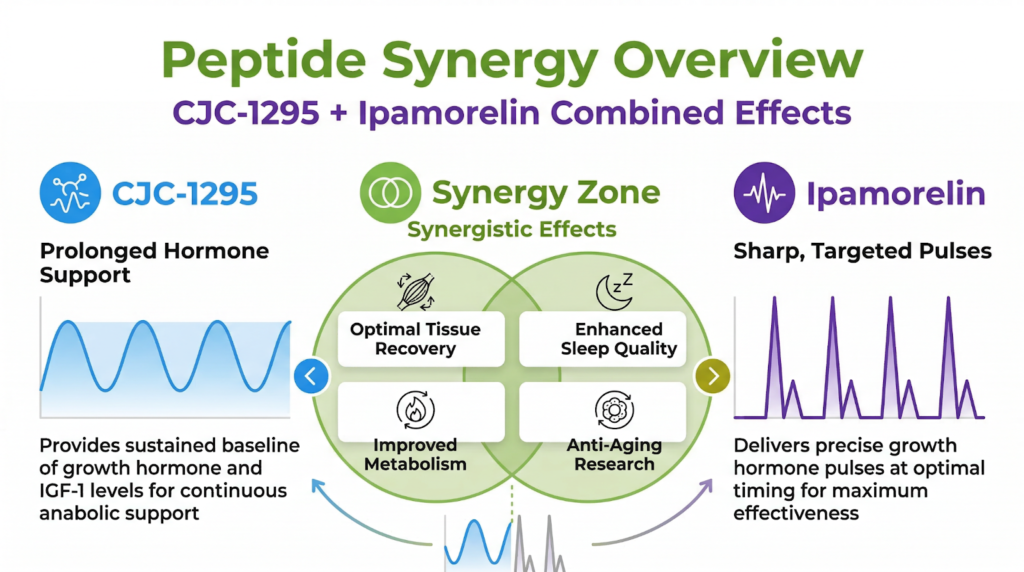
The main reason scientists are combining CJC-1295 and Ipamorelin in experimental research is that their actions complement each other. CJC-1295 is known for providing a long-lasting stimulus to the body’s growth hormone networks, prompting the pituitary gland to release growth hormone steadily, leading to increased GH and IGF-1 levels. This supports experiments observing cumulative effects of higher growth hormone—like ongoing tissue repair, improved metabolism, and chronic adaptation .
Ipamorelin, on the other hand, acts as a selective growth hormone-releasing peptide, sending quick, targeted pulses that mimic natural hormone patterns. It precisely triggers growth hormone without affecting cortisol or prolactin, making it valuable for research on hormone release during sleep or recovery .
When both CJC-1295 and Ipamorelin are introduced together, their effects overlap, creating a balanced environment for tissue support, recovery, improved energy, and healthy aging. Research is keen to see if this synergy translates into enhanced resilience, better metabolic flexibility, and more consistent biological rhythms as models face greater demands .
Fat Burning and Lean Muscle Development
Both peptides have recently sparked research interest for their potential impacts on fat burning (lipolysis) and lean muscle development.
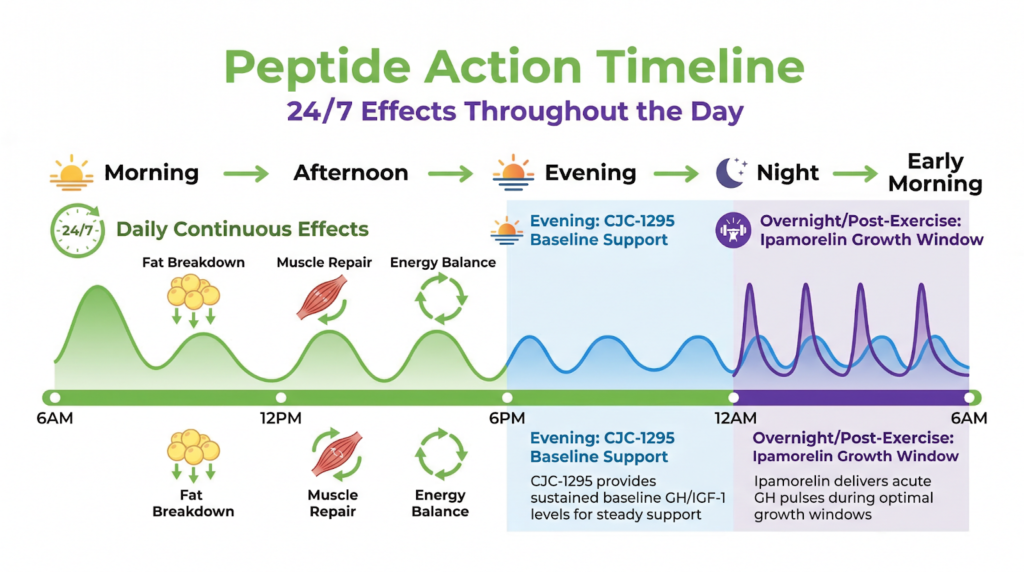
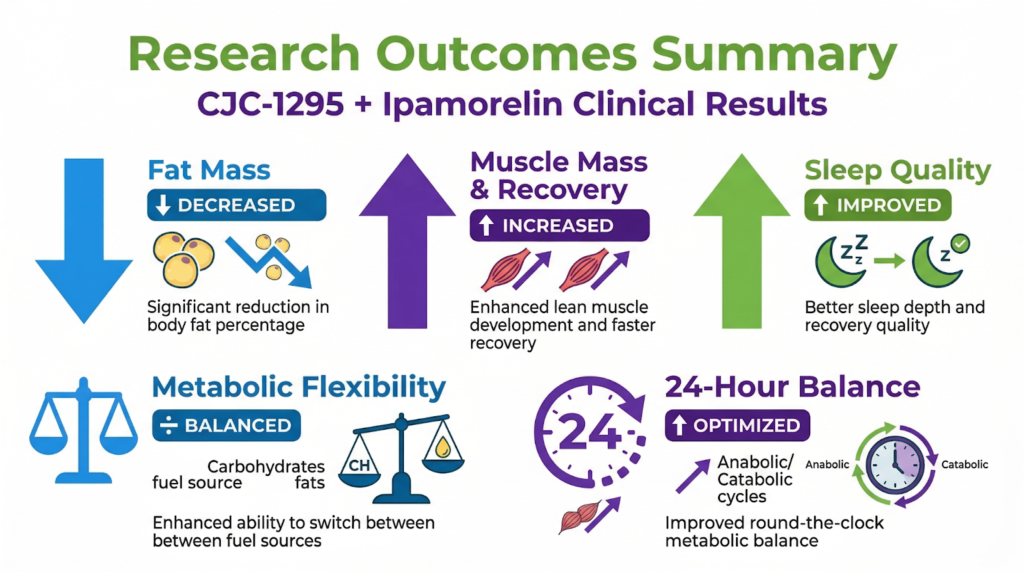
CJC-1295 extends growth hormone signaling, resulting in higher GH and IGF-1, which promotes shifting the body’s energy usage from fat storage to fat burning. Elevated GH encourages the breakdown of stored triglycerides—lipolysis—freeing up fatty acids for energy, not storage. This sustained lipolytic effect helps researchers model how higher growth hormone exposure improves fat loss and metabolic flexibility over time .
Ipamorelin delivers targeted bursts of hormone, closely mimicking the body’s natural rhythms. These pulses are often studied for maximizing acute fat-burning, especially during sleep or after exercise, and do so without boosting unwanted hormones like cortisol .
Together, the stack creates a sustained but balanced environment that supports breaking down stored fat (even during caloric restriction or stress), while also fueling lean muscle growth and efficient recovery. For muscle development, sustained GH/IGF-1 from CJC-1295 bolsters protein synthesis and repair, while Ipamorelin’s pulses further enhance these effects during optimal windows—like post-workout or overnight recovery. This cascade supports ongoing muscle gains, maintenance, and improved physical recovery in research models .
Benefits Often Explored in Research
- Collagen & Joint Support: Improved tissue strength and resilience under stress .
- Muscle Recovery: Faster muscle repair and less soreness after exertion .
- Sleep Quality: Larger GH pulses during deep sleep and more time spent in restorative phases .
- Metabolic & Energy Balance: Increased fat utilization, improved body composition, more stable energy levels, and appetite control .
- Healthy Aging: Greater recovery capacity and tissue function as models age .
- Fat Mass Reduction & Muscle Gains: Lower fat stores, larger muscle fibers, and stronger recovery markers over time .
- Metabolic Flexibility: Enhanced switching between carbs and fats as energy sources, contributing to healthier metabolic function .
How Do CJC-1295 & Ipamorelin Work Together?
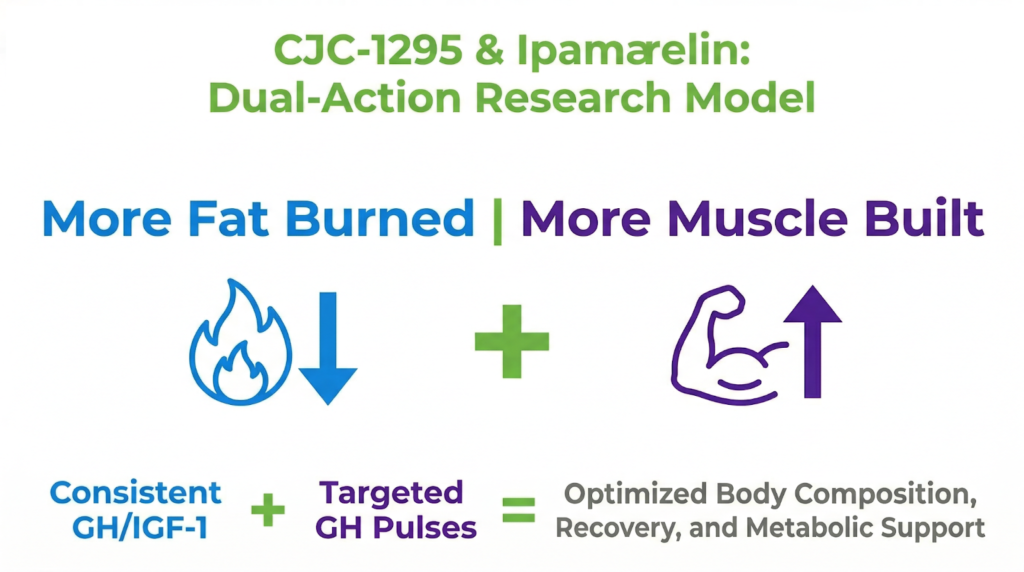
CJC-1295 is engineered to stay longer in the body, keeping the pituitary gland receiving prompts for hours instead of minutes, elevating growth hormone and IGF-1 in a sustained yet physiologically harmonious fashion. This supports studies needing a consistent anabolic environment .
Ipamorelin, acting via the ghrelin receptor, sends acute growth hormone bursts that don’t increase stress hormones, mirroring the body’s natural responses to stress, food, and sleep. The stack optimizes the benefits of both approaches, enhancing repair, energy, and long-term resilience, even under repeated physical challenges or in aging models .
Real-World Observations & Frequently Asked Questions
Researchers often observe :
- Deeper sleep and higher sleep quality
- Improved morning energy and alertness
- Faster recovery and less post-exercise soreness
- Better joint comfort and tissue quality over weeks
- Noticeable improvements in body composition (fat loss, muscle gain, efficiency)
Who investigates this stack? Aging research teams, tissue repair experts, metabolic researchers, sleep and circadian rhythm studies, and scientists optimizing experimental peptide protocols .
FAQ Highlights:
- Why combine the peptides? To explore if sustained hormone elevation plus timed pulses enhance recovery, metabolism, and sleep quality .
- Typical protocol? Both peptides are usually administered in the evening to mirror circadian patterns .
- Scope of research: Ranges from physical recovery and sleep to healthy aging and energy regulation .
- Stacking with others: Sometimes protocols include BPC-157, TB-500, or other peptides for multi-targeted research .
Safety & Compliance
CJC-1295, Ipamorelin, and related peptides are intended solely for research and laboratory use. Not approved for human use, their sale and distribution for consumer use are not regulated by the FDA. All content is for educational purposes; follow appropriate research ethics and institutional guidelines .
References
- Teichman SL et al., Journal of Clinical Endocrinology and Metabolism, 2006.
- Ionescu M, Frohman LA., Journal of Clinical Endocrinology and Metabolism, 2006.
- Raun K et al., European Journal of Endocrinology, 1998.
- Johansen PB et al., Growth Hormone and IGF Research, 1999.
Beck DE et al., Journal of Surgical Research, 2014.